Outdoor Living in La Nucia
La Nucia is a modern inland town of 20,000 residents where 52% are expats — British, Dutch, and Scandinavian — attracted by affordable hillside properties, world-class sports facilities, and a thriving Sunday rastro market.
La Nucia has reinvented itself over the past two decades. Once a sleepy agricultural village behind Benidorm, it is now one of the most forward-thinking municipalities on the Costa Blanca, with a nationally recognised sports complex and infrastructure that rivals towns three times its size. The Sunday rastro market draws thousands weekly as one of the largest fresh-produce markets in the Alicante province.
Properties average around €250,000, and for that price you get a detached villa with a private pool, mountain views, and a terrace significantly larger than what the same budget buys on the coast — often 40–80 square metres of outdoor space. At roughly 200 metres elevation, summer evenings are cooler than the seafront and winter days are crisp and sunny — perfect for a long kamado cook.
The community is active and outdoorsy. Hiking, cycling, and using the town’s Olympic-grade sports facilities are all part of daily life. That culture feeds directly into outdoor cooking — residents here treat grilling as fuel for an active lifestyle, not just a weekend novelty.
La Nucia offers hillside villas with 40–80m² outdoor spaces averaging €250,000, cooler summer evenings than the coast, and an active expat community of 10,000+ who cook outdoors year-round.
Choosing Your Setup in La Nucia
La Nucia’s spacious hillside terraces and mild inland climate make it ideal for versatile setups combining gas BBQs for convenience with kamado grills or pizza ovens for weekend cooking projects.
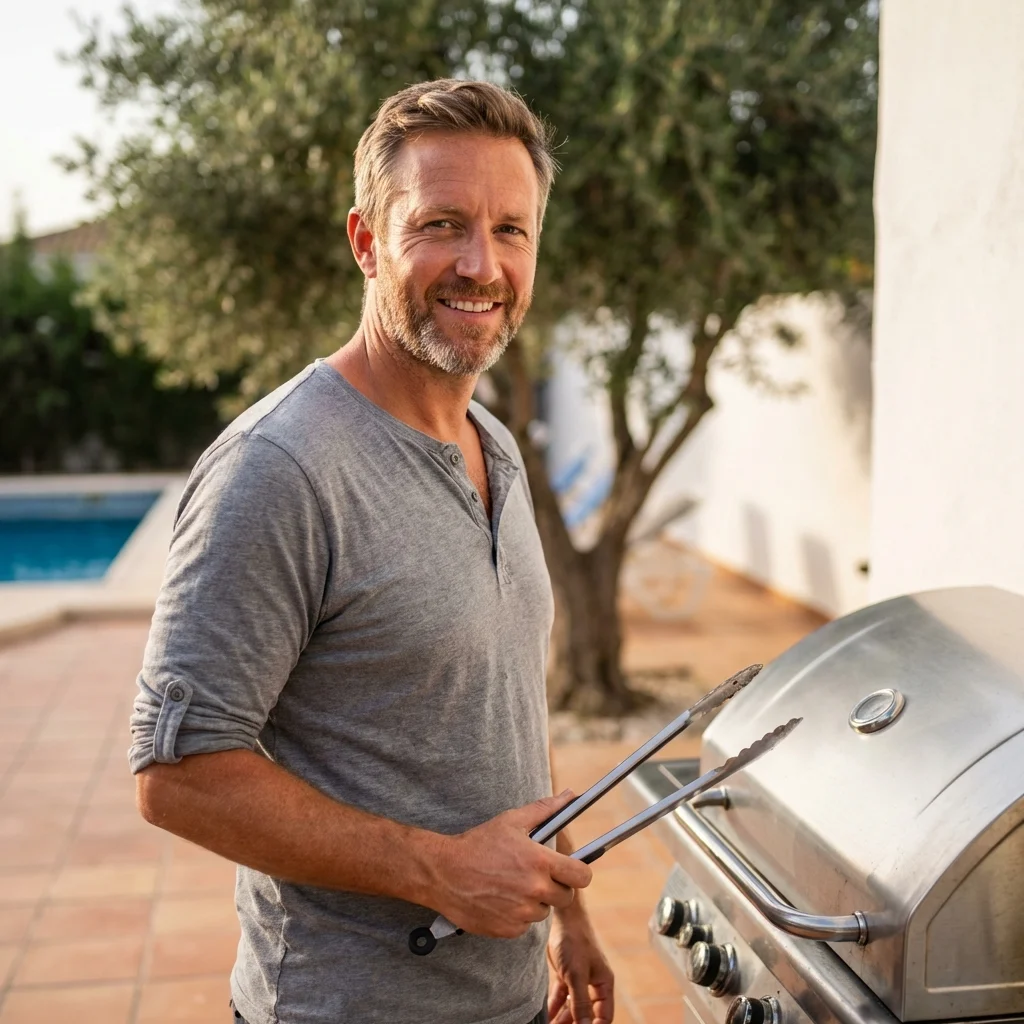
The typical La Nucia property has enough space for a multi-piece outdoor cooking setup without feeling crowded. A common configuration we install here is a gas BBQ for weeknight speed paired with a kamado grill for weekend slow-cooking — positioned apart on the terrace so both can run simultaneously when entertaining.
Costa Blanca Outdoors recommends considering the slightly cooler inland evenings when choosing equipment. A kamado grill retains heat brilliantly and performs just as well at 12°C in January as it does at 35°C in July — making it arguably the best single-piece investment for La Nucia’s year-round cooking season. The ceramic insulation also means fuel efficiency, using roughly half the charcoal of an open grill for the same cooking time.
Wood-fired pizza ovens are a natural fit. La Nucia’s inland position means firewood is more accessible and affordable than on the coast. Orange groves and almond orchards surround the town, and suppliers sell seasoned wood by the sack or trailer load. The Sunday rastro itself is a reliable source for firewood and charcoal.
Costa Blanca Outdoors recommends kamado grills as the best single-piece investment for La Nucia, with ceramic insulation performing equally well in January at 12°C and July at 35°C while using half the charcoal of open grills.
Delivery to La Nucia
We deliver to La Nucia on our central inland route weekly, with experience navigating the town’s hillside residential streets and gated urbanisations.
La Nucia sits just inland from our Benidorm–Alfaz del Pi coastal route, making it a natural addition to our central delivery schedule. Most residential areas have wide roads, though some older hillside urbanisations require smaller vehicles for heavy items.
Every delivery includes full setup: unpacking, assembly, placement on your terrace or in your garden, and a walkthrough of your new equipment. For built-in outdoor kitchen projects, we work with local builders who understand La Nucia’s municipal building guidelines and community regulations.
Alfaz del Pi and Benidorm are on the same delivery corridor, and we also reach Altea and the northern coast from here. Expect 5–10 working days for in-stock items, or 3–4 weeks for custom kitchen installations including design, fabrication, and professional fitting.
Illuminating the Terrace and Garden Culture of La Nucía
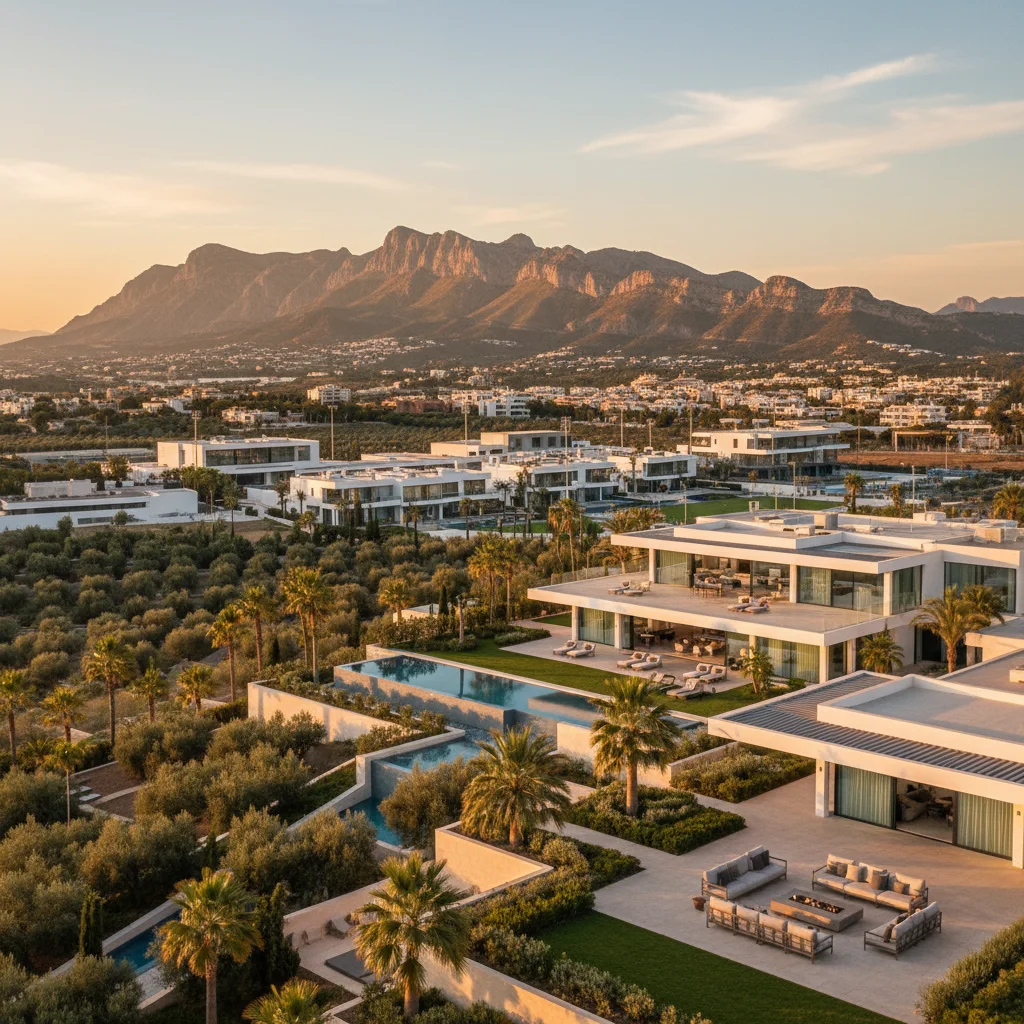
Living on the edge of the Marina Baixa provides a unique topographical advantage that directly influences how we design our homes. With a population of roughly 20,000 residents, this municipality has evolved into a sophisticated residential hub where over half the population consists of international expats. This demographic shift, led largely by British, Dutch, and Norwegian families, has fundamentally changed the local approach to outdoor living. Unlike the traditional Spanish townhouses of the old center, the sprawling urbanisations surrounding the Ciutat Esportiva and stretching toward the mountain backdrop demand a lighting strategy that serves both function and high-end aesthetics. We are no longer just putting a single bulb over a door; we are creating evening environments that rival the interior comfort of a €230,000 villa. The international influence here has brought a specific demand for outdoor kitchens and "hygge" inspired terrace layouts that require layered lighting to work effectively after the sun dips behind the Sierra Aitana.
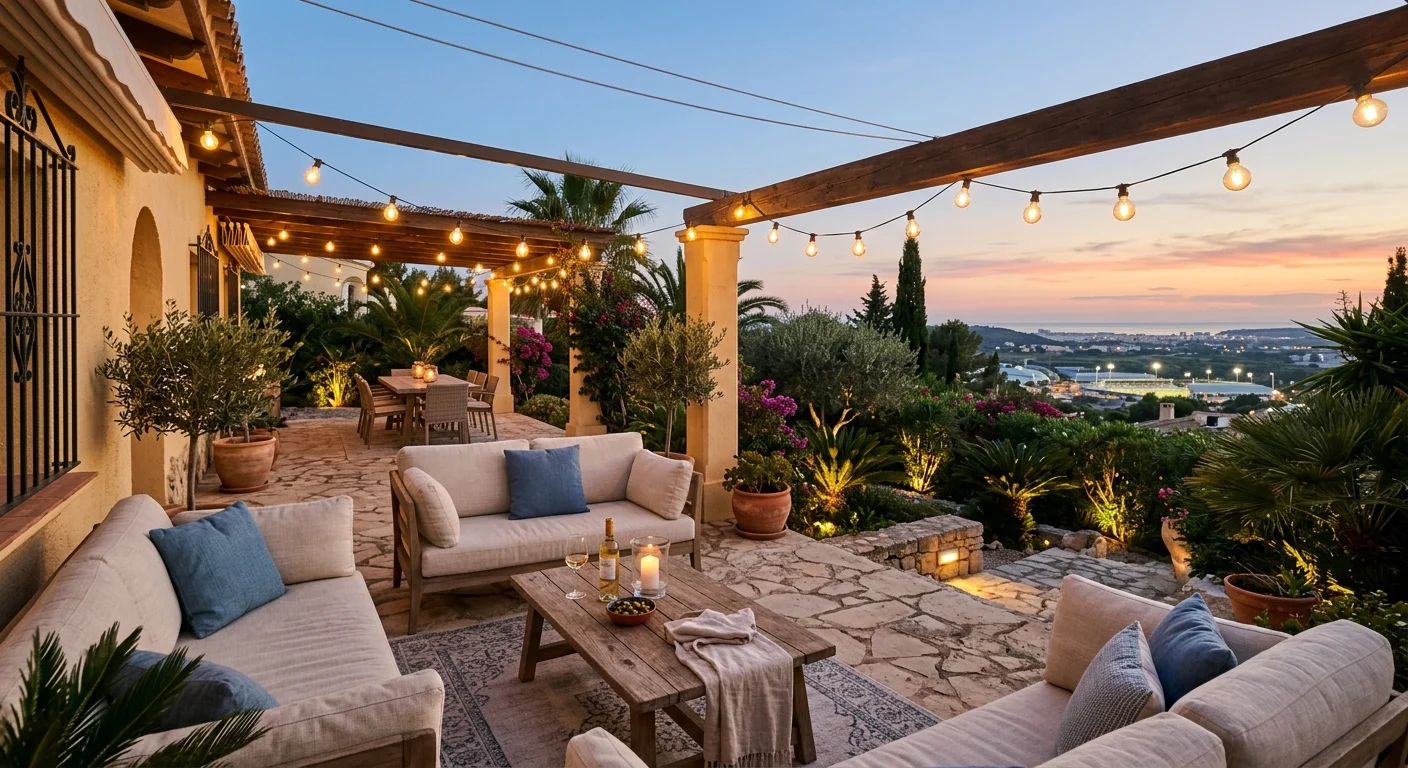
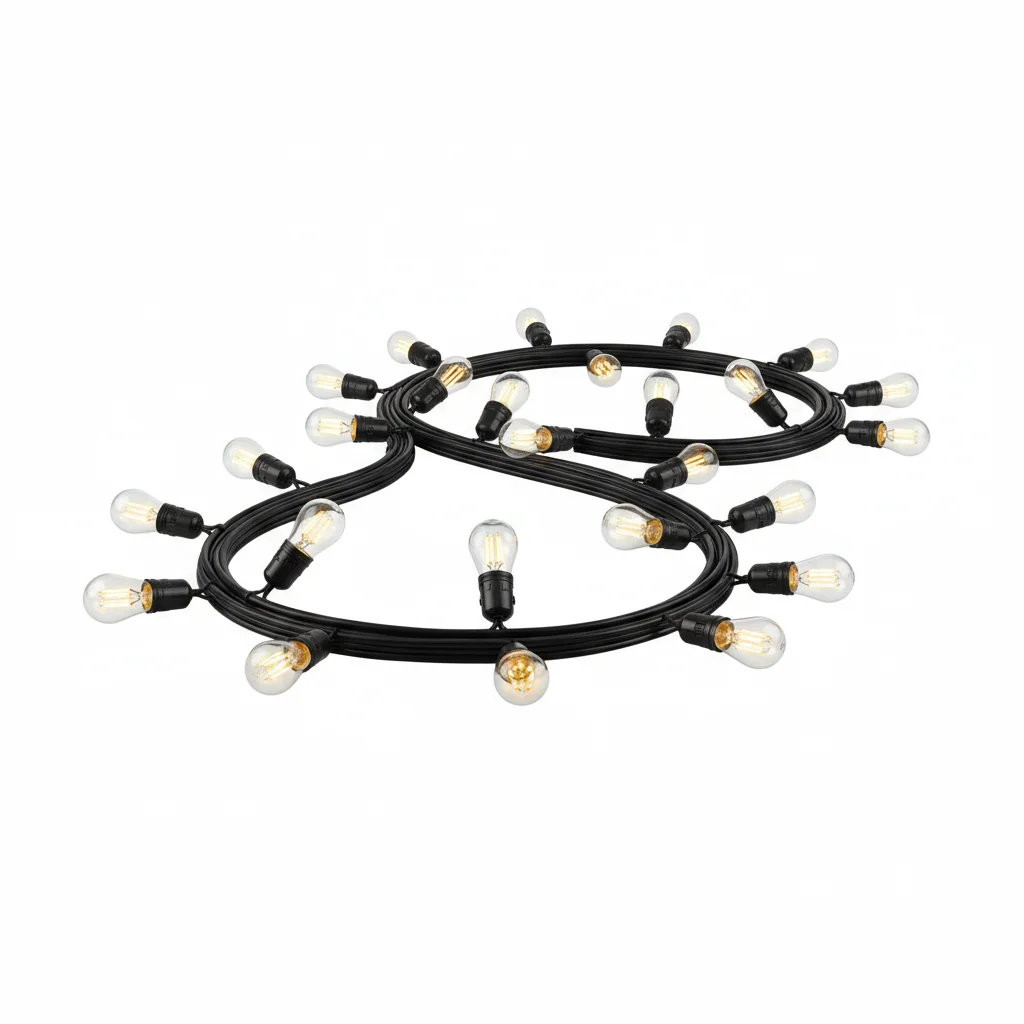
The architectural diversity in this part of the Costa Blanca is significant. You might be managing a compact balcony in a modern apartment block or a sprawling garden in a detached villa with views over the valley toward Altea. Each requires a different intensity and placement of light. On a typical Sunday, after visiting the local market to pick up plants or furniture, many residents realize that their outdoor spaces lose all utility the moment it gets dark. Proper illumination bridges that gap. For the Norwegian and Dutch communities particularly, there is a strong preference for warm-toned architectural lighting that highlights the stone textures of the local construction. British residents often lean toward social lighting, such as festoon strings or integrated LED systems for dining areas. Because we are situated in an elevated position compared to Benidorm, our evenings can feel slightly cooler and more atmospheric, making the "warmth" provided by 2700K or 3000K LED bulbs a psychological necessity as much as a visual one.
Effective lighting here isn't just about visibility; it’s about defining zones. In a garden with a mountain backdrop, the darkness can feel immense. By placing low-voltage LED spotlights at the base of olive trees or palms, you create a sense of boundary and security without the harshness of traditional floodlights. This approach respects the local environment while maximizing the footprint of your property. For those living in the more densely populated areas near the town center, lighting serves to reclaim privacy. Strategically placed lights can draw the eye toward a focal point, like a water feature or a curated plant bed, and away from the neighboring terrace. We see a lot of families who have moved here for the sporting facilities and active lifestyle, and for them, lighting the outdoor space is about extending the day for children to play or for hosting dinners that last well into the early hours of the morning.
Technical Requirements for the Local Environment
The microclimate of the area presents several challenges that standard off-the-shelf lighting from a big-box retailer simply cannot handle long-term. Although we are slightly inland, we are still within the 2km "salt spray zone" whenever the Levante wind blows in from the coast. This salt-laden air is incredibly corrosive to cheap metals. I have seen countless stainless steel lamps pitted and rusted within six months because they were not 316 Marine Grade or high-quality powder-coated aluminum. When selecting fixtures, you must look for an IP (Ingress Protection) rating of at least IP65 for general areas and IP67 for anything near a pool or ground-level path. The intense UV radiation we experience year-round is the second silent killer of outdoor equipment. Cheap plastics will become brittle and yellow within a single summer season. I recommend investing in polycarbonate or glass lenses that are UV-stabilized to ensure the clarity of the light remains consistent over the years.
The wind profile here is another factor that many newcomers overlook. The Levante and Poniente winds can be exceptionally strong as they whip through the valley. This makes the installation of festoon lighting or hanging lanterns a technical task rather than a simple DIY job. Festoon strings must be tensioned with galvanized steel guidewires to prevent the cables from snapping or pulling out of the wall fixings during a storm. For wall-mounted architectural lighting, we use heavy-duty anchors because the thermal expansion and contraction of local Mediterranean render can cause standard plastic wall plugs to loosen over time. If you are part of a Comunidad de Propietarios in an urbanisation like Bello Horizonte or Panorama, you must also be mindful of light pollution rules. Many communities now require "down-lighting" only, meaning the bulb must be shielded from the top to prevent light from spilling into neighbors' windows or obscuring the night sky.
From a maintenance perspective, the local dust—often brought over by "calima" Saharan rain—means that lighting fixtures need to be accessible for cleaning. A glass-faced LED spotlight costing around €85 might look great, but if it is mounted five meters up a wall without a simple way to wipe the red dust off the lens, its performance will drop by 40% within a month. For those looking for security combined with aesthetics, I often suggest integrated PIR (Passive Infrared) sensors on sleek, modern sconces priced around €120 to €160. These provide safety when you return home at night but don't stay on permanently, which helps keep your electricity bills manageable. In Spain, where electricity costs fluctuate, moving toward high-efficiency LEDs is non-negotiable. A 10W LED can produce the same output as an old 60W halogen, allowing you to light an entire garden for the same energy cost as a single old-fashioned porch light.
Tailored Configurations for Local Property Types
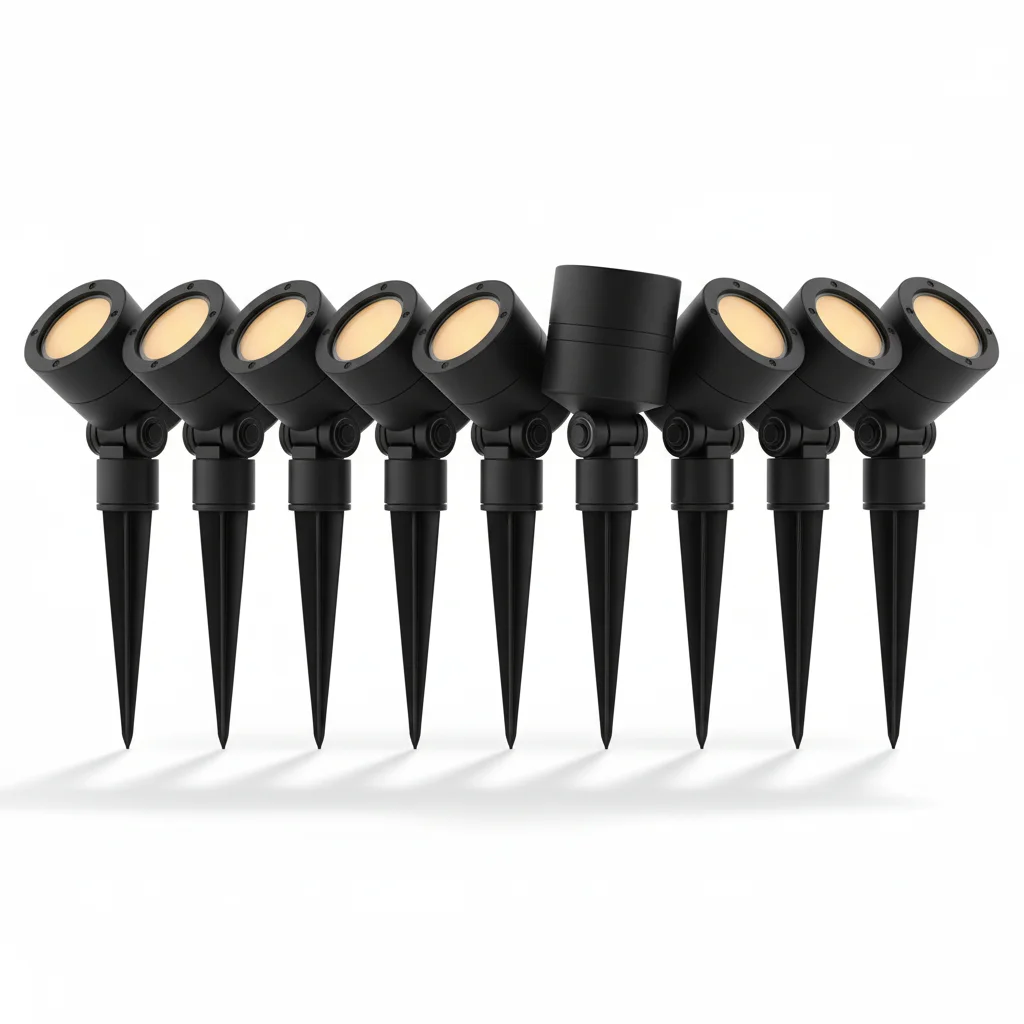
If you are living in a villa with a medium-to-large garden, the most effective setup is a three-layer system. Start with path lighting using bollard lights spaced roughly three meters apart. For a standard 20-meter driveway or garden path, this ensures safety without creating a "runway" effect. Next, add accent lighting. We recommend 5W or 7W LED spikes that can be pushed into the soil to highlight specific flora. If you have recently installed artificial grass—which is very common here to save on water—these spikes can be positioned around the perimeter to create a soft glow across the turf. A full villa lighting package, including a transformer, cabling, and 12-15 high-quality fixtures, typically ranges from €1,200 to €1,800. This investment not only improves usability but significantly increases the curb appeal and resale value of the property in a competitive market.
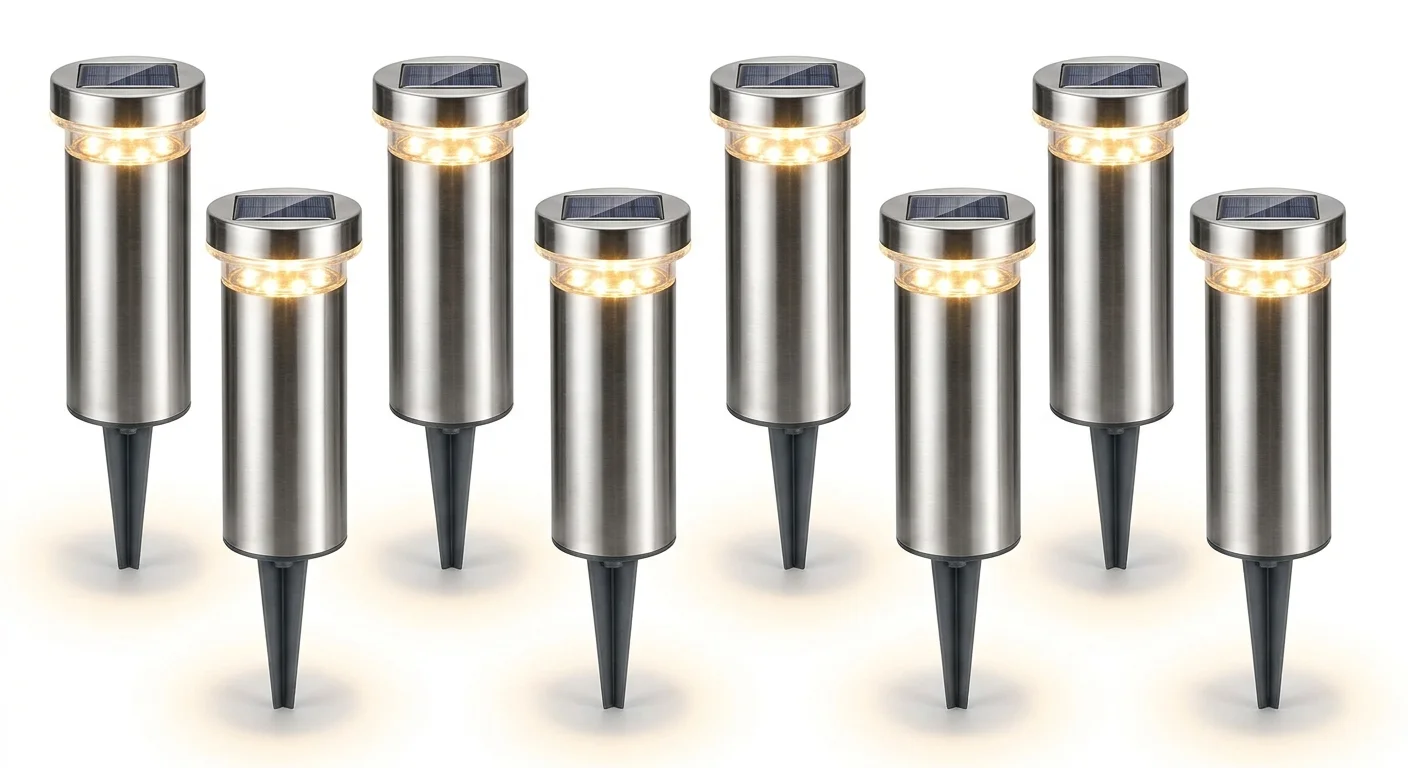
For residents in apartments or penthouses near the town center or the Ciutat Esportiva, the focus shifts to "atmosphere" and space maximization. Balconies here are often exposed to high winds, so heavy, floor-based lanterns or integrated rail lighting are better choices than hanging items. Solar technology has improved significantly, and for a sunny South-facing balcony, a set of high-lumen solar deck lights or a premium solar table lamp (priced around €75 to €110) can provide enough light for an evening meal without the need for drilling holes or running trunking across your tiles. If you have garden fencing or privacy screening on your terrace, mounting slimline LED strips or "brick lights" into the structure can create a beautiful wash of light that makes the space feel larger and more enclosed. We often find that combining lighting with garden fencing helps to define the "outdoor room" concept that is so popular with British and Dutch expats.
One specific recommendation I always make for this area is the use of smart controllers. With the intense sun, your lighting needs change seasonally. A smart system allows you to program your lights to come on at sunset—which changes significantly between December and June—and dim down at midnight to save energy. This is particularly useful for holiday homeowners who want to give the impression of occupancy when they are back in the UK or Northern Europe. You can also group your zones, so your security lighting stays active while your decorative "party" lights remain off. For a standard installation, adding a smart hub and localized controllers usually adds about €200 to the total project cost but provides a level of convenience that pays for itself in peace of mind.
Regional Expertise and Professional Delivery
Operating from this central point on the Costa Blanca allows us to serve the surrounding areas of Alfaz del Pi, Benidorm, Altea, and Finestrat with ease. My team and I are familiar with the specific logistical hurdles of these towns, from the narrow, winding streets of the Altea old town to the strict delivery windows in the high-rise sectors of Benidorm. When we deliver to La Nucía, we understand the local geography—we know how to navigate the steep inclines of the mountain-side urbanisations and the access restrictions that often apply to larger delivery vehicles. We don't just drop a box at your gate; we understand the terrain and the properties because we have worked on over 200 of them across the region since 2019.
Our knowledge extends beyond the products to the actual installation environment. We know that the ground here is often hard limestone or "caliche," which requires specific tools if you are planning to bury cables for garden lighting. We also understand the local electrical standards and can advise on how to safely tap into your existing home system. Whether you are looking for a simple set of festoon lights to brighten up a summer BBQ or a complete architectural lighting design for a new-build villa, we bring a level of local expertise that you won't find with an online-only retailer or a general hardware store. We have seen what fails in this climate and what lasts, and we only stock the latter.
If you are unsure where to start, I recommend a walk through your garden or terrace at dusk. Notice where the shadows fall and where you naturally want to sit. Lighting is a personal choice, but it must be grounded in the practicalities of our Mediterranean environment. We offer a free consultation service where we can discuss your specific layout, look at your existing electrical points, and suggest a configuration that fits your budget and style. From a €50 solar spotlight to a €2,000 professional-grade garden transformation, we provide the hardware and the local knowledge to ensure your outdoor space is as beautiful at night as it is during the day. Contact us to discuss how we can help you make the most of those warm Costa Blanca evenings.
 JW'"
/>
JW'"
/>