Outdoor Living in Benidorm
Benidorm has 77,000 residents with a remarkable 35% expat population — a year-round resort city with the largest British and Northern European community on the Costa Blanca, where high-rise terraces and hilltop villas create a unique vertical outdoor living market.
Benidorm defies the clichés. Behind the famous skyline lies a genuine residential city with a well-established international community that lives here permanently, not just on holiday. The British contingent is the largest, followed by significant German and Dutch populations, creating a social infrastructure — clubs, restaurants, and activity groups — that operates twelve months a year.
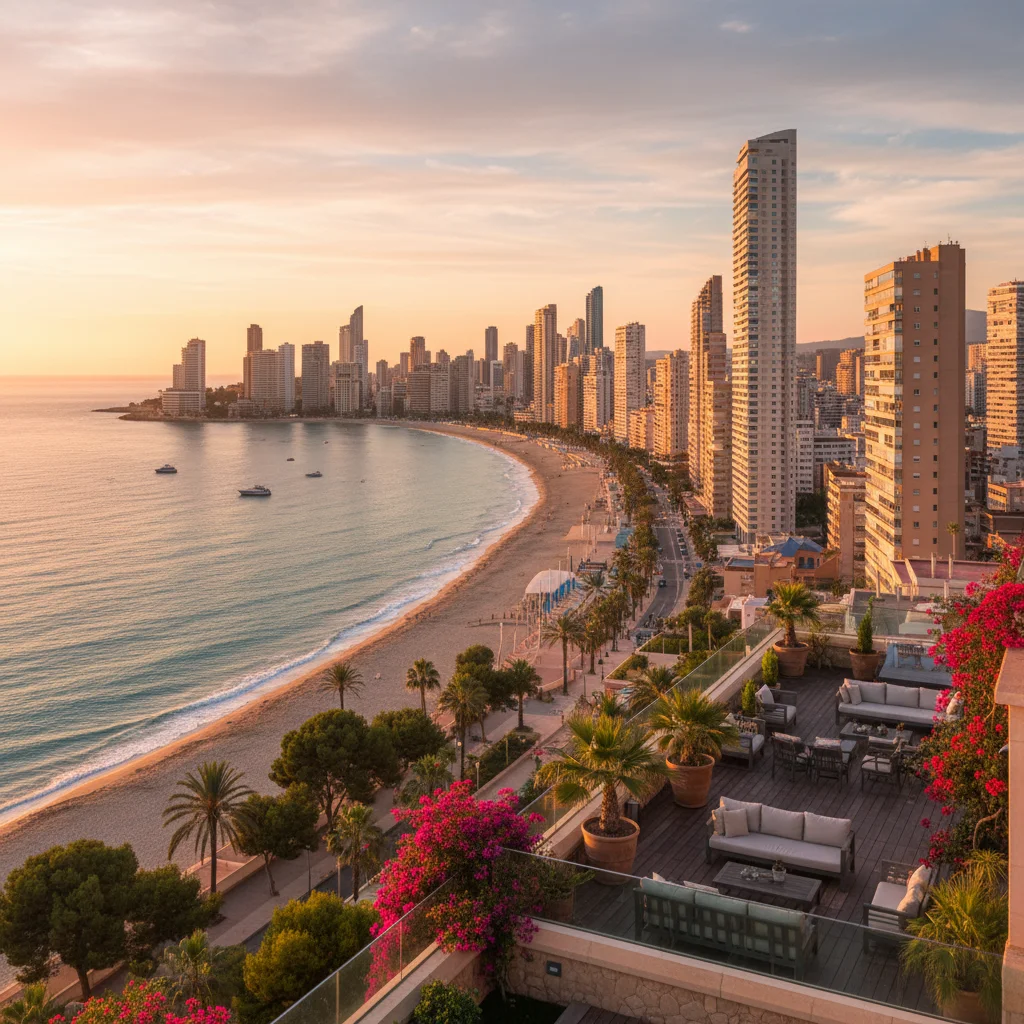
The city divides naturally into distinct zones. Levante Beach on the east side is the busier, more commercial strip, while Poniente Beach to the west has a more residential feel with modern apartment towers and the striking promenade designed by Carlos Ferrater. Between them, the Old Town clusters around the Balcón del Mediterráneo headland with its whitewashed streets and traditional restaurants. Behind the beaches, the terrain rises sharply into the hills toward Finestrat and La Nucia, where villa communities enjoy elevated panoramas over the entire bay.
Property prices average around €250,000, though the range is wide. High-rise apartments with sea-view terraces of 10–20 square metres dominate the beachfront, while hillside villas behind the city offer gardens and covered terraces of 40–80 square metres. Penthouse apartments in newer Poniente towers can have wraparound terraces exceeding 30 square metres — prime outdoor cooking territory.
Benidorm’s massive year-round expat community, diverse property types, and unrivalled social scene make it the highest-volume market on the Costa Blanca for outdoor cooking equipment.
Choosing Your Setup in Benidorm
Benidorm’s vertical living means compact, high-performance equipment for apartment terraces, while hilltop villa owners have the space for full outdoor kitchen installations with views over the bay.
High-rise living dominates Benidorm, and that shapes equipment choices. A typical Levante or Poniente apartment terrace of 10–15 square metres suits a compact kamado (38cm) or a quality two-burner gas BBQ — small footprint, serious output. Kamados are particularly popular in high-rise settings because they produce minimal smoke, an important consideration when neighbours are directly above and below. Costa Blanca Outdoors stocks several kamado models specifically suited to balcony use, with stand options that protect terrace tiles from heat.
Penthouse owners along the Poniente strip and in newer developments near the Old Town have more room to work with. A three- or four-burner gas BBQ with side burner, paired with a portable pizza oven, creates a complete outdoor cooking station on a 25–30 square metre terrace. These setups become the social hub of the home — Benidorm’s active community calendar means regular hosting is the norm rather than the exception.
Villa owners in the hills behind Benidorm, toward Sierra Cortina and the Finestrat border, have space for the full range. Built-in outdoor kitchens with gas grills, wood-fired pizza ovens, and preparation areas are increasingly popular in these elevated properties, where entertaining on a terrace overlooking the Mediterranean is the ultimate selling point.
For Benidorm apartments, Costa Blanca Outdoors recommends low-smoke kamado grills or compact gas BBQs designed for high-rise terrace use — with full outdoor kitchen solutions available for hillside villa owners.
Delivery to Benidorm
We deliver throughout Benidorm, from the Levante and Poniente high-rises to the Old Town and hillside villa communities, on our weekly central Costa Blanca route.
Benidorm’s high-rise apartment blocks require careful delivery planning. We coordinate lift access, building entry codes, and delivery timing with building administrators in advance. For towers without freight lifts, we assess stairwell access and arrange appropriate equipment — our team regularly delivers to upper floors in Levante and Poniente towers and knows the logistics of Benidorm’s major residential buildings well.
The Old Town area around the Balcón del Mediterráneo has narrow, pedestrianised streets. Deliveries here are scheduled during early morning access windows, with smaller vehicles navigating the historic quarter. Hillside villa deliveries toward Sierra Cortina and the Finestrat border are typically straightforward, with direct road access to most urbanisaciones.
Neighbouring Alfaz del Pi and La Nucia are on the same delivery route, and we also serve Altea and Villajoyosa on our central coastal schedule. In-stock items ship within 5–10 working days, while custom outdoor kitchen projects require 3–4 weeks for design, fabrication, and professional installation.
Outdoor Lighting in Benidorm: Technical Requirements for the Marine Environment
Living on this specific stretch of the Costa Blanca since 2019 has taught me that light is the single most important factor in extending the usability of a home. With an average property price hovering around 250,000 EUR, many residents here are balancing the compact, high-altitude living of beachfront apartments with the more expansive garden spaces found in the surrounding hills. This town of 77,000 residents is unique because of its verticality and its dual exposure to both the sea and the mountain winds. Whether you are situated near the iconic Levante Beach or tucked away in the quieter streets of the Old Town, your outdoor illumination needs to be far more resilient than what you would find in an inland city like Madrid or even just ten kilometers away in the protected valleys.
The international community here, making up 35% of the population, has a distinct way of utilizing outdoor space. My British, German, and Dutch clients often prioritize outdoor cooking and dining areas that remain functional long after the sun sets behind the Balcón del Mediterráneo. However, the technical challenge of lighting these spaces is often underestimated. You are dealing with a microclimate where the salt spray from the Mediterranean is carried by the wind up to 2km inland, coating every surface in a corrosive layer. If you install standard lighting fixtures, you will find the finishes pitting and the internal electronics failing within a single season. Proper illumination here is not just about aesthetics; it is about choosing materials that can withstand the specific chemical and physical stresses of this coastal location.
The property types in this area range from 40m² balconies on the 20th floor of a tower to 800m² villa plots on the outskirts. Each requires a different philosophy of light. In the denser urban areas near Poniente Beach, the goal is often to create a private sanctuary that blocks out the ambient orange glow of the streetlights while providing enough task lighting for a late dinner. In the more open villa areas, lighting serves a dual purpose of security and architectural definition. I have helped over 200 families navigate these choices, and the most common mistake is over-lighting. Because the night sky here is often clear, a small amount of strategically placed, high-quality light goes much further than a floodlight that washes out the natural contours of your terrace and creates glare for your neighbors.
Practical Engineering for the Costa Blanca Climate
When selecting fixtures for a home in this region, the first thing I look at is the IP rating and the material composition. The salt spray is relentless. For any light fixture installed within sight of the water, I strictly recommend 316 Marine Grade Stainless Steel or high-quality brass. Standard 304 stainless steel, which is common in many hardware stores, will develop "tea staining"—a brown, rusty discoloration—within months of exposure to the Levante wind. This wind brings humidity and salt directly from the sea, while the Poniente wind brings dry heat and fine dust from the interior. This combination acts like sandpaper on cheap finishes. If you are opting for aluminum fixtures, they must be "marine grade" powder-coated to prevent the paint from bubbling and peeling.
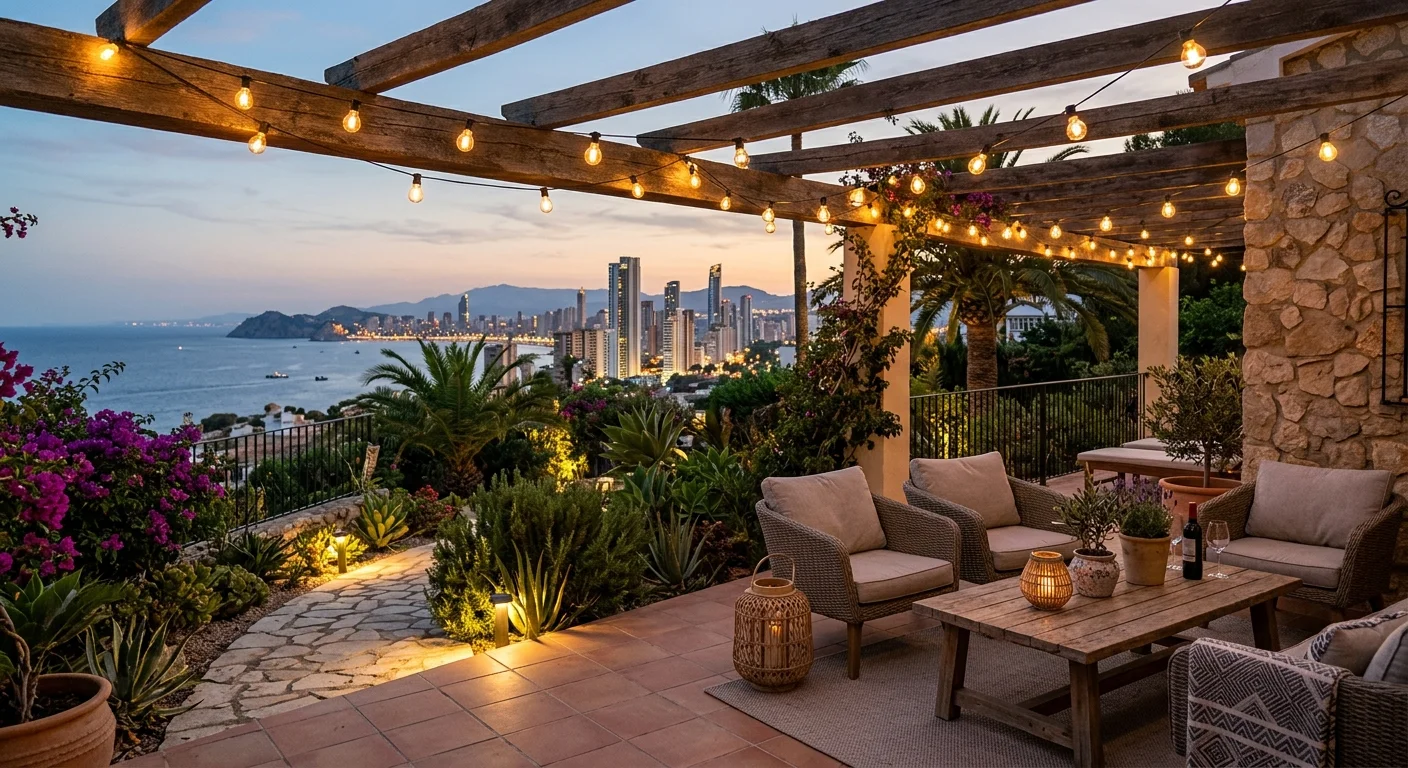
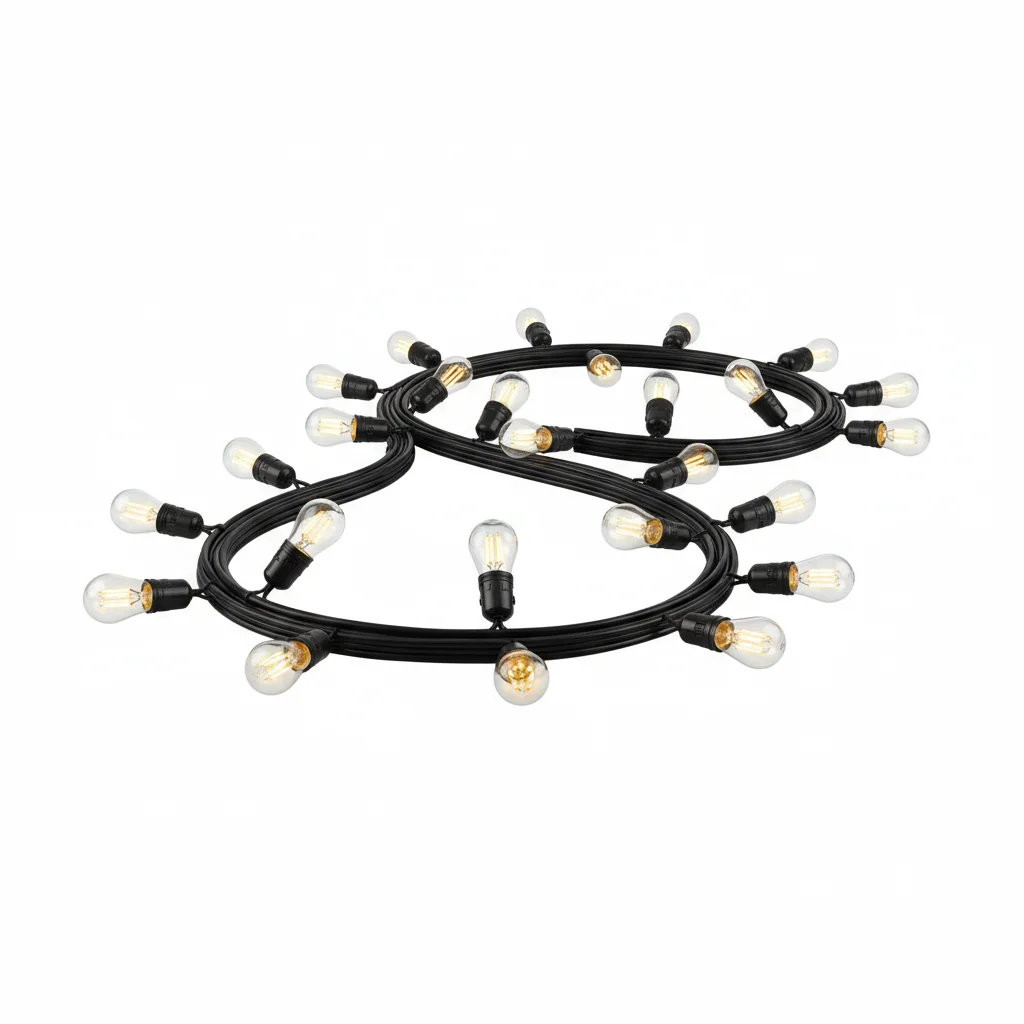
The UV index here is another silent killer of outdoor equipment. I have seen countless plastic solar lights purchased for 20 EUR that literally crumble in your hand after one summer because the plastic hasn't been UV-stabilized. When I specify lighting for a terrace, I look for polycarbonate lenses or tempered glass that won't yellow or become brittle. For those looking for a reliable entry point, a set of professional-grade LED festoon lights with heavy-duty rubber cabling (H05RN-F) and IP65-rated sockets usually starts around 180 EUR for a 15-meter string. Unlike the thin PVC versions, these will not crack under the intense July sun or snap when the gusts pick up speed.
Community rules, or the normas de comunidad, are a significant factor for those living in the many high-rise complexes. Most comunidades de propietarios have strict regulations regarding the appearance of the building's facade at night. You cannot simply bolt any fixture to the external walls. I often recommend "floating" lighting solutions—weighted floor lamps or perimeter lighting that sits within the footprint of your balcony. For a standard 15m² balcony, a combination of three recessed floor spots and a single high-quality table lamp can transform the space for a total investment of approximately 450 EUR. This avoids any conflict with the community president while providing a sophisticated, tiered lighting scheme.
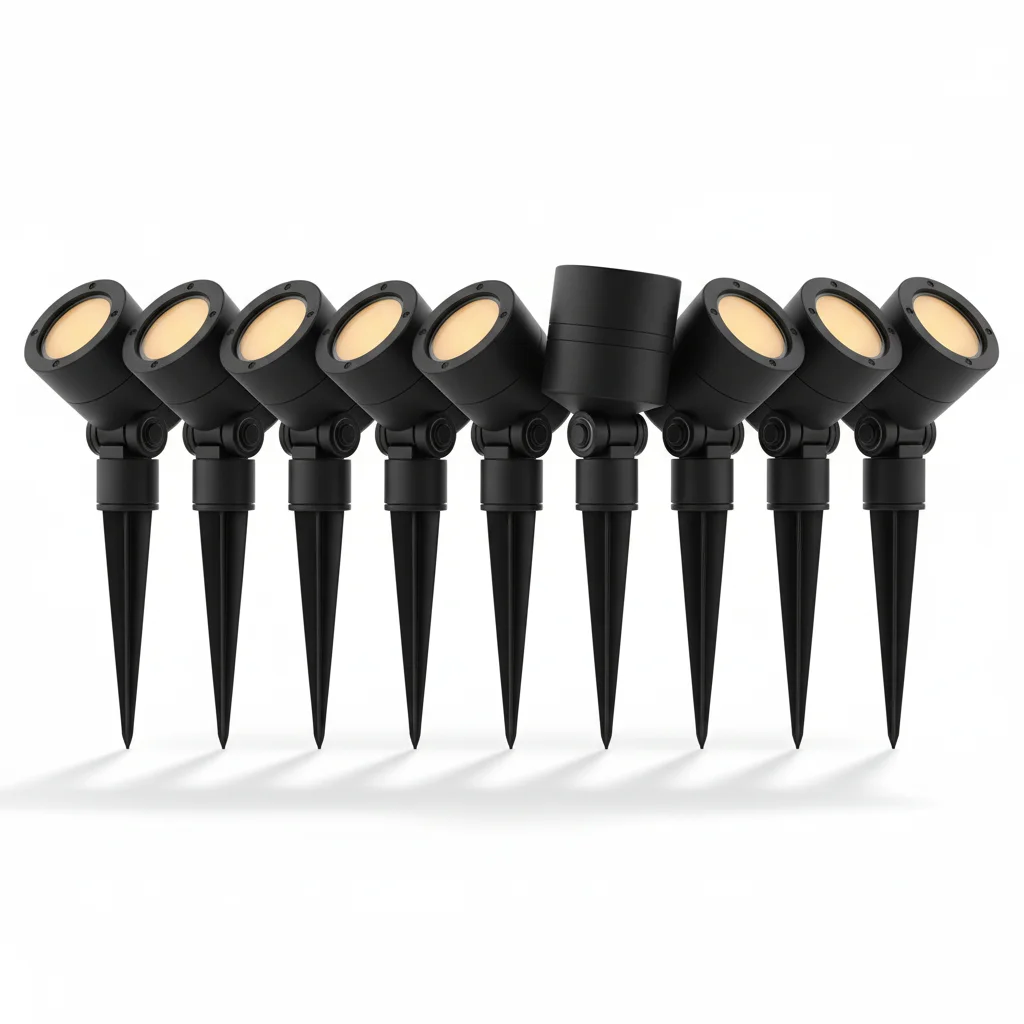
Installation in these high-rise properties also requires a specific understanding of the building's construction. Many of the older towers in the center have solid concrete balconies with very little depth for recessed wiring. In these cases, we use slimline surface-mounted tracks or discreet conduit that blends into the masonry. For villa owners, the focus shifts to the "hardscape." If you have installed artificial-grass, the lighting should be integrated into the borders or tucked into the garden-fencing to create depth. A common setup I recommend for a medium-sized villa garden involves a 12V low-voltage system. This is safer, easier to install around existing landscaping, and far more flexible than 220V systems. A high-quality 150W transformer and a starter kit of six directional LED spotlights will typically cost between 600 EUR and 800 EUR.
Strategic Recommendations Based on Property Type
For the villa owners in the quieter residential zones, I suggest a layered approach that emphasizes the perimeter and the natural features of the plot. If you have installed garden-fencing for privacy, you have the perfect canvas for backlighting. Placing small, shielded upward-facing spots at the base of the fence every three meters creates a soft glow that defines the boundary of your property without being intrusive. This works exceptionally well when paired with artificial-grass. By installing recessed "brick" lights or small 1W marker lights into the sub-base before the turf is laid, you can create a safe, illuminated pathway that looks incredibly sharp at night. The contrast between the dark green of the 40mm pile grass and the warm 2700K light of the LEDs creates a high-end feel that increases the perceived value of the property.
In the beachfront apartments where space is a premium, the strategy changes to "vertical lighting." Since floor space is limited, we use the walls and the ceiling of the balcony to create the illusion of more room. I recommend using "up-and-down" wall lights. These fixtures cast a cone of light both upwards to the ceiling and downwards to the floor, which softens the overall ambiance and reduces harsh shadows. For a high-rise balcony near the Old Town, I would suggest a pair of these in an anthracite finish to match the modern joinery, which usually costs around 120 EUR per unit. This setup provides enough light for reading or dining without the need for a bright overhead light that attracts insects.
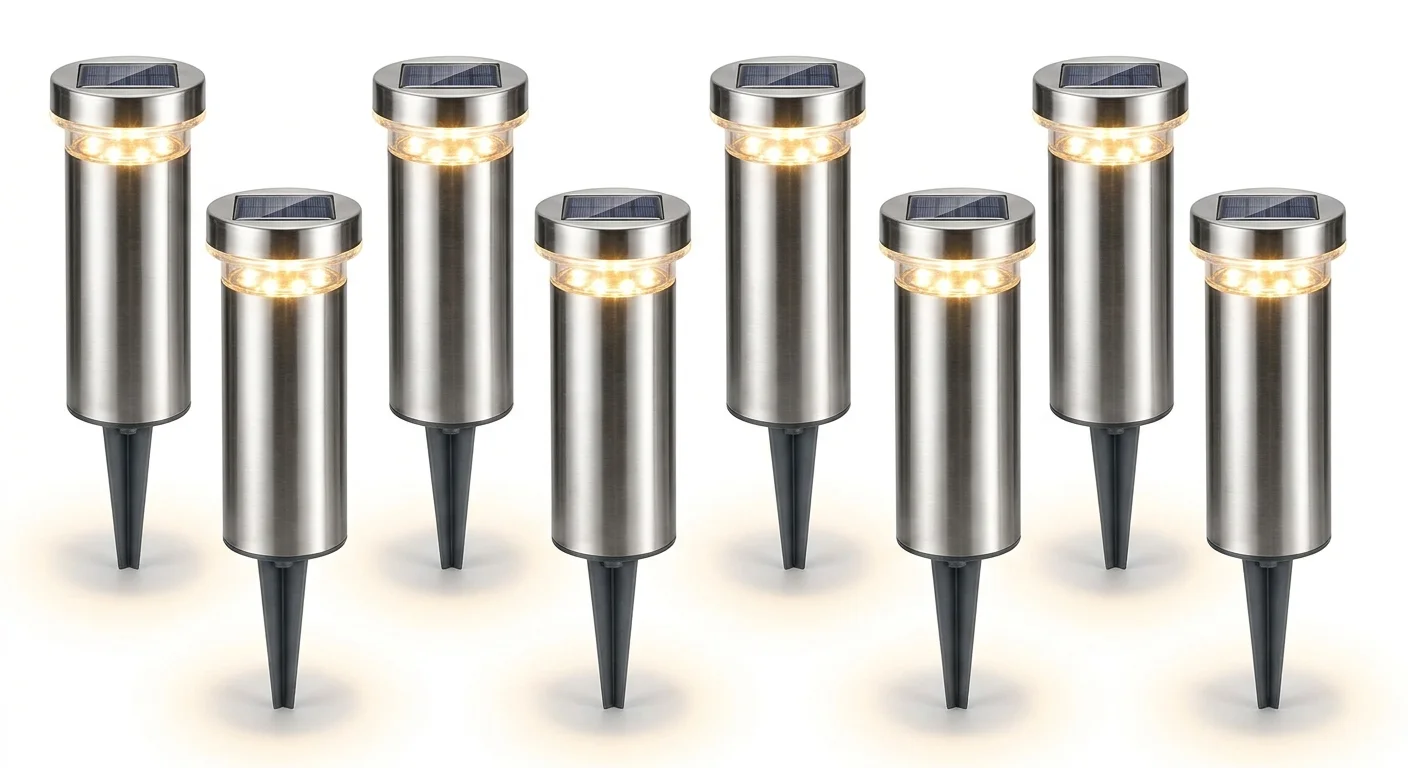
Maintenance is the final piece of the puzzle that many people overlook. Because of the dust and salt, you should expect to wipe down your light lenses at least once every three months. If you don't, the light output can drop by as much as 30% as the grime builds up. For solar-powered options, this is even more critical. While I am generally cautious about solar in Benidorm due to the high failure rate of cheap units, professional-grade solar pillars with oversized monocrystalline panels and replaceable lithium batteries are a viable option for areas where running cable is impossible. A single 60cm solar bollard of this quality will cost around 250 EUR, but it will actually work for 6-8 hours a night, even in the shorter days of December.
The goal is to create a seamless transition between the interior of your home and the exterior. By using warm white LEDs (between 2700K and 3000K), you mimic the interior lighting of a living room, making the terrace feel like a natural extension of the house. This is particularly important for the 35% of residents who are expats; we often want that cozy, indoor-outdoor flow that the Spanish climate allows for nearly 300 days a year. Avoid "cool white" or blueish lights at all costs—they make the outdoor space feel clinical and highlight every speck of dust on your tiles.
Local Logistics and Expert Implementation
Transporting and installing lighting systems in this part of the coast requires more than just a van and a ladder. I regularly serve clients in the surrounding areas of Alfaz-del-Pi, Finestrat, and La Nucía, and each has its own logistical quirks. In the center of the town, particularly near the pedestrianized zones and the narrow climbs toward the Old Town, delivery logistics have to be timed perfectly with the local "carga y descarga" hours. Many of the newer developments in Finestrat have steep access roads that require specialized vehicles for larger architectural lighting orders or long-run fencing materials.
When we deliver to a high-rise, we coordinate directly with the conserje or building manager. Delivering a complete lighting overhaul for a penthouse often involves navigating service elevators and tight corridors. My team understands these building layouts intimately, from the classic towers near the Levante beachfront to the modern complexes rising on the hillsides. We know which buildings have sensitive electrical systems that require specific surge protection—a must-have in this region where summer storms can cause significant power spikes.
I also take into account the prevailing winds when mounting any overhead lighting or festoons. In Alfaz-del-Pi and La Nucía, the wind can funnel through the valleys with surprising force. We use tensioned stainless steel "messenger wires" for all festoon installations to ensure the weight of the lights isn't pulling directly on the electrical connections. This prevents the sagging and snapping that often occurs with DIY installations after a particularly windy night.
If you are looking to truly transform your outdoor space, I invite you to reach out for a consultation. I don't just sell boxes of lights; I provide a layout that works for the way you live. We can discuss how to integrate your lighting with your artificial-grass project or how to mount fixtures to your new garden-fencing without compromising its structural integrity. Every property from the beachfront to the mountains has a different story, and the right lighting is how you tell it. I can help you select the exact fixtures that will survive the salt, resist the UV, and provide the perfect atmosphere for your terrace for years to come.
 JW'"
/>
JW'"
/>