What is a Bioclimatic Pergola and How Do Orientable Louvres Work?
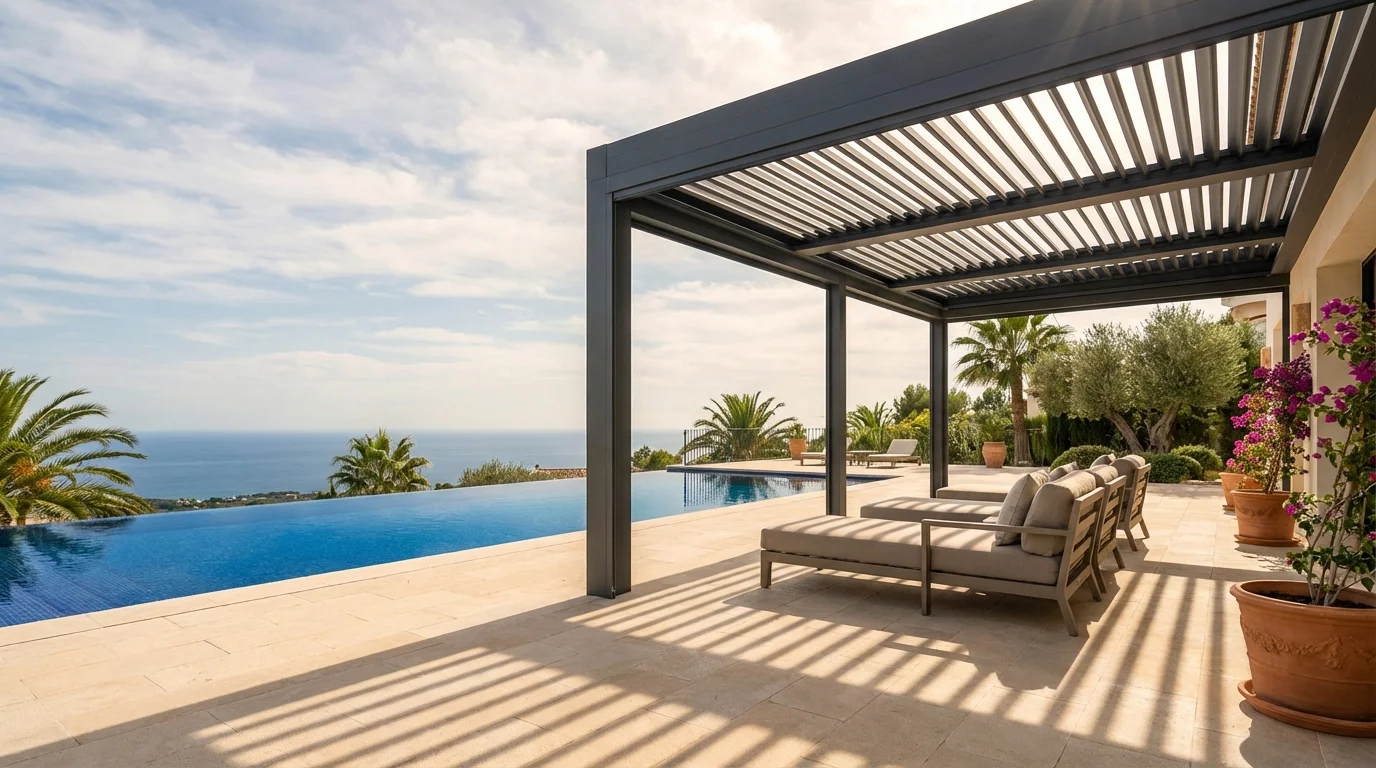
A bioclimatic pergola is an advanced outdoor aluminium structure designed to regulate the microclimate of your terrace, garden, or patio naturally. Unlike traditional fixed roofs or fabric awnings, a bioclimatic pergola features a smart roof made of motorized, orientable louvres (lamas orientables). These louvres adjust their angle of inclination to control sunlight, ventilation, and temperature, allowing you to enjoy your outdoor living space on the Costa Blanca all year round.
The core technology relies on the precise rotation of these hollow aluminium louvres. By adjusting the louvres to different angles, you can achieve three distinct modes of operation:
- Ventilation Mode (45 to 90 degrees): The louvres are partially opened. This creates a natural chimney effect (efecto chimenea). Warm air rises and escapes through the openings, while a cool breeze is drawn in underneath. This can lower the temperature on your Alicante terrace by up to 8 degrees Celsius without any air conditioning.
- Sun Protection Mode (10 to 45 degrees): The louvres are angled to block direct solar radiation while still allowing natural light to filter through. This is essential during the intense summer months in coastal towns like Altea, Javea, or Torrevieja.
- Watertight Mode (0 degrees): When fully closed, the louvres seal together with high-performance rubber gaskets. This creates a completely flat, waterproof roof that protects your outdoor furniture from sudden Mediterranean downpours, channeling rainwater into an integrated internal drainage system.
Ficha Técnica: Technical Specifications and Standards
To ensure your installation can withstand the coastal conditions of the Alicante province, every pergola bioclimatica must meet strict European manufacturing standards. Below is the technical datasheet for our professional-grade systems.
| Technical Parameter | Specification / Performance | European Standard / Certification |
|---|
| Wind Resistance | Up to 175 km/h (Clase 6) | UNE-EN 13659 |
| Louvre Rotation | Motorised from 0 degrees to 145 degrees | CE Certified |
| Snow Load Capacity | 100 kg per square metre | CTE (Código Técnico de la Edificación) |
| Rainwater Drainage | Integrated internal perimeter guttering | UNE-EN 12056-3 |
| Structural Material | Extruded Aluminium 6063-T6 | Qualicoat Seaside / Qualideco |
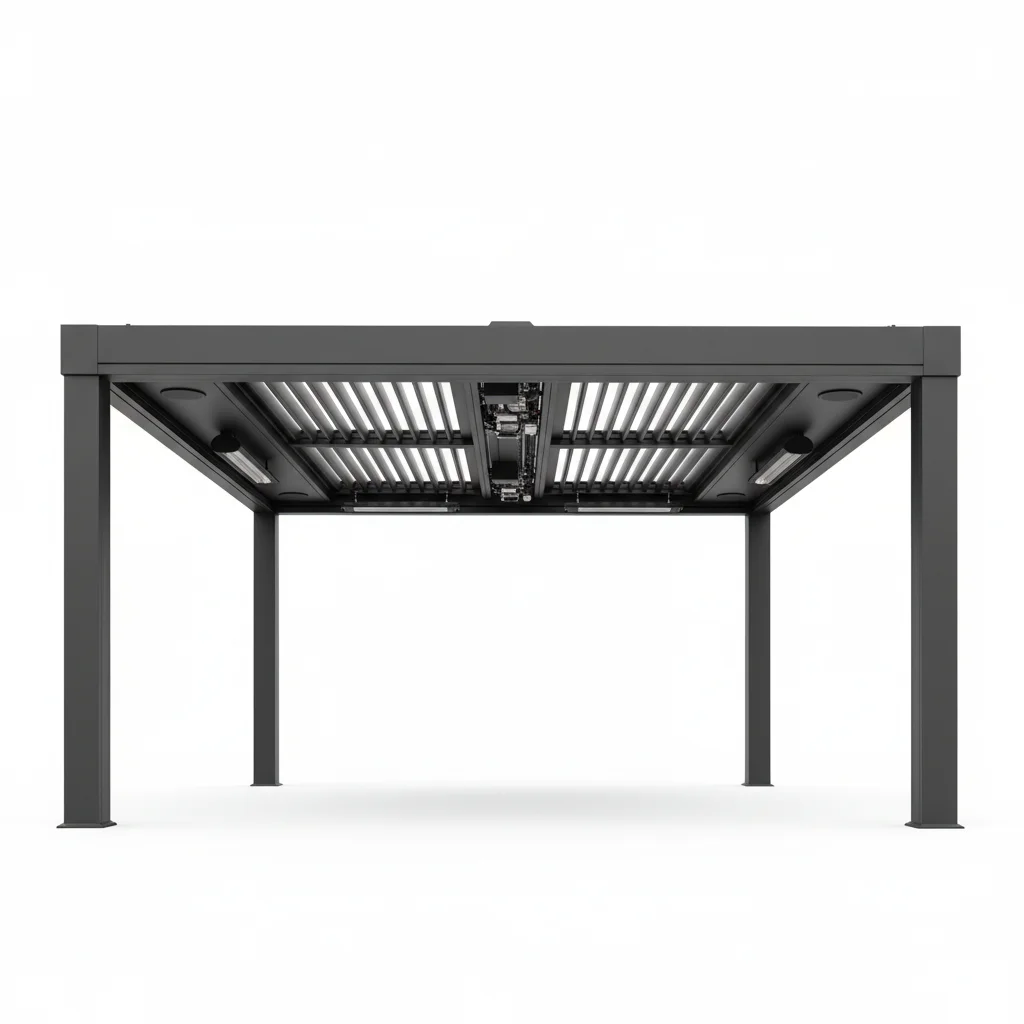
| Automation & Sensors | Integrated Rain, Wind, and Sun sensors | IP67 Waterproof Rating |
| Hardware & Screws | Grade A4 / 316 Stainless Steel | High salinity corrosion resistance |
Bioclimatic Pergola Models: Adosada, Autoportante, and Retráctil
Choosing the right structural configuration is key to maximizing the usability of your outdoor space. On the Costa Blanca, we install three primary types of bioclimatic pergolas, each suited to specific architectural layouts and exposure levels.
Pergola Bioclimática Adosada (Wall-Mounted)
This model is anchored directly to the structural wall of your home on one side, supported by two or more aluminium pillars at the front.
- When to choose it: This is the ideal option for extending your indoor living room, kitchen, or dining area onto the terrace. It is highly popular in modern villas in Altea Hills, Moraira, and Denia, where homeowners want a seamless transition between indoor and outdoor spaces. It also provides excellent thermal insulation for the house facade by shading large glass patio doors.
Pergola Bioclimática Autoportante (Freestanding)
A self-supporting structure that stands independently on four or more structural pillars, requiring no connection to an existing wall.
- When to choose it: Perfect for creating a dedicated chill-out zone, pool house, or outdoor dining area away from the main building. If you have a large garden plot in Elche, Mutxamel, or San Vicente del Raspeig, a freestanding pergola allows you to create an independent oasis next to your swimming pool or outdoor kitchen.
Pergola Bioclimática Retráctil (Retractable)
The ultimate high-end solution. In this model, the aluminium louvres do not just rotate; they also slide back to one side of the frame, leaving up to 85 percent of the roof area completely open to the sky.
- When to choose it: Recommended for penthouses in Alicante city or south-facing terraces where you want absolute control over winter sunlight. During the cooler winter months, you can retract the roof completely to allow maximum sunlight into your home, reducing heating costs.
Turnkey Price Guide for Bioclimatic Pergolas in Alicante
The cost of a bioclimatic pergola on the Costa Blanca varies depending on the dimensions, structural type, and integrated accessories. Below is an orientative turnkey price table including professional installation, structural anchoring, and electrical connection.
| Project Description / Configuration | Dimensions (Metres) | Orientative Price (Turnkey, VAT incl.) |
|---|
| Standard Adosada (Motorised, Louvres) | 3.00 x 3.00 m | From 5,000 EUR |
| Standard Autoportante (Motorised) | 4.00 x 4.00 m | From 9,000 EUR |
| Retractable Bioclimatic Pergola | Per square metre | From 500 EUR per square metre |
| Standard Louvered Pergola (No extras) | Per square metre | From 300 EUR per square metre |
| Combo: Pergola + Glass Curtains | 3.00 x 3.00 m | From 8,000 EUR |
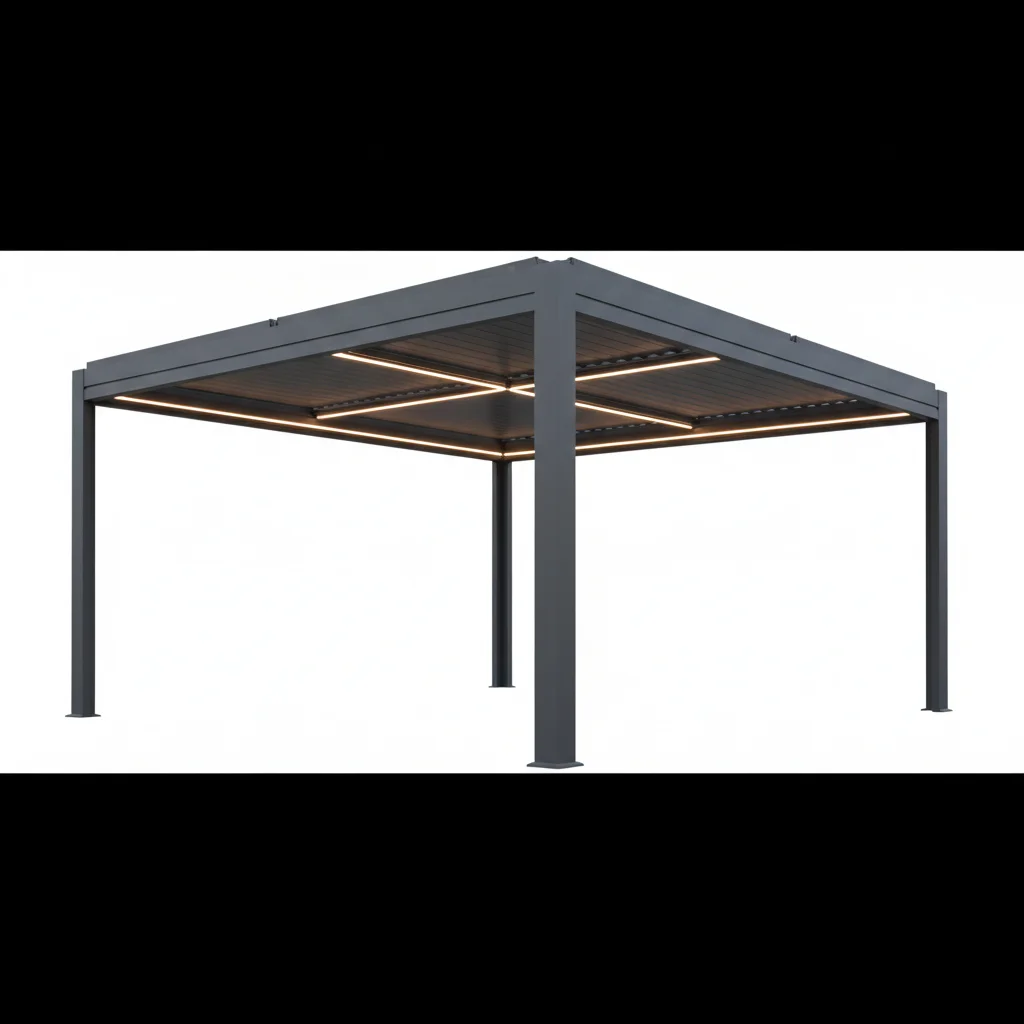
| Add-on: Integrated Perimeter LED Strip | Custom fit | Plus 300 EUR |
| Add-on: Automated Rain and Wind Sensor | Plug and play | Plus 200 EUR |
Note: These prices are orientative. Exact quotes depend on the complexity of the ground anchoring (e.g., drilling into high-grade porcelain tiles on concrete slabs) and access difficulties, which are common in cliffside properties in Javea or Calpe.
Comparison: Bioclimatic Pergola vs Toldo, Cerramiento, and Pergola Fija
To understand why a pergola bioclimatica is the premier choice for Mediterranean homes, it is helpful to compare it to alternative shading and enclosure systems.
| Feature / Criteria | Pergola Bioclimática | Toldo (Awning) | Cerramiento de Cristal | Pérgola Fija (Wood/Metal) |
|---|
| Turnkey Cost | Medium to High | Low to Medium | Medium to High | Medium |
| Rain Protection | Excellent (100 percent watertight) | Poor (water pools on fabric) | Excellent | Good (if tiled/polycarbonate) |
| Ventilation Control | Excellent (adjustable louvres) | Limited | Poor (creates greenhouse effect) | None |
| Winter Usability | High (with heaters/glass) | Very Low | Excellent | Medium |
| Wind Resistance | Class 6 (Up to 175 km/h) | Low (must retract in wind) | High | High |
| Maintenance | Low (occasional hose wash) | High (fabric rots/fades) | Medium (frequent glass cleaning) | High (wood needs painting) |
Installation Process and Obra Menor Licences on the Costa Blanca
Installing a bioclimatic pergola is a clean, dry, and fast process, but it requires professional expertise to ensure structural safety and compliance with local municipal regulations.
The Installation Process
- Technical Site Survey: We measure the terrace slope, check the structural integrity of the wall (for adosada models), and locate underground utilities or drainage pipes.
- Foundation and Anchoring: The pillars must be securely anchored. On Costa Blanca terraces, this usually involves chemical anchors drilled into the concrete slab beneath the porcelain tiles.
- Frame Assembly: The perimeter beams and gutters are assembled, followed by the installation of the central structural beam.
- Louvre and Motor Integration: The aluminium louvres are clicked into their pivots, and the internal Somfy or Cherubini motor is wired.
- Sealing and Testing: High-grade MS polymer sealants are applied to all joints. We run water tests to verify the drainage system and program the wind and rain sensors.
Obra Menor Licences and Regulations
In most municipalities across the Alicante province (including Alicante, Elche, Benidorm, and San Juan), a bioclimatic pergola is classified as a “bien desmontable” (a demountable structure). Because it does not have a concrete roof and can be disassembled, it generally does not add to the permanent constructed volume of your property (no computa edificabilidad).
However, you should always submit a Declaración Responsable para Obra Menor (Responsible Declaration for Minor Works) to your local Ayuntamiento. This is a simple, quick administrative process that prevents municipal fines. If your villa is located within a community of owners (Comunidad de Propietarios), you will also need written permission from the community administrator before starting the installation.
Why the Costa Blanca Climate Demands a Bioclimatic Solution
The Alicante coastline enjoys a unique microclimate with over 300 days of sunshine per year, but it also presents harsh environmental challenges that quickly destroy low-quality outdoor installations.
The Power of the Levante Wind
Coastal areas like Santa Pola, Torrevieja, and Calpe are frequently hit by the strong Levante wind. Traditional fabric awnings (toldos) must be retracted whenever the wind exceeds 30 km/h to prevent the arms from bending or the fabric from tearing. A Class 6 certified bioclimatic pergola can withstand winds up to 175 km/h, meaning you can leave it closed or angled during windy days without any risk of structural failure.
Protection Against Intense Solar Radiation
With summer temperatures regularly exceeding 35 degrees Celsius, unprotected terraces become unusable from June to September. The orientable louvres reflect the harsh overhead sun while letting the sea breeze circulate freely, keeping the terrace cool.
Fighting Salitre (Marine Corrosion)
If you live within 5 kilometres of the Mediterranean Sea, marine salinity (salitre) is your biggest enemy. Salt spray corrodes standard metals and destroys cheap electric motors within seasons. Our installations use only extruded aluminium with Qualicoat Seaside powder coating and marine-grade stainless steel hardware. The motors are fully sealed with an IP67 rating, ensuring that the salt air cannot penetrate the electrical components, guaranteeing a lifespan of over 20 years on the Costa Blanca.
 JW'"
/>
JW'"
/>