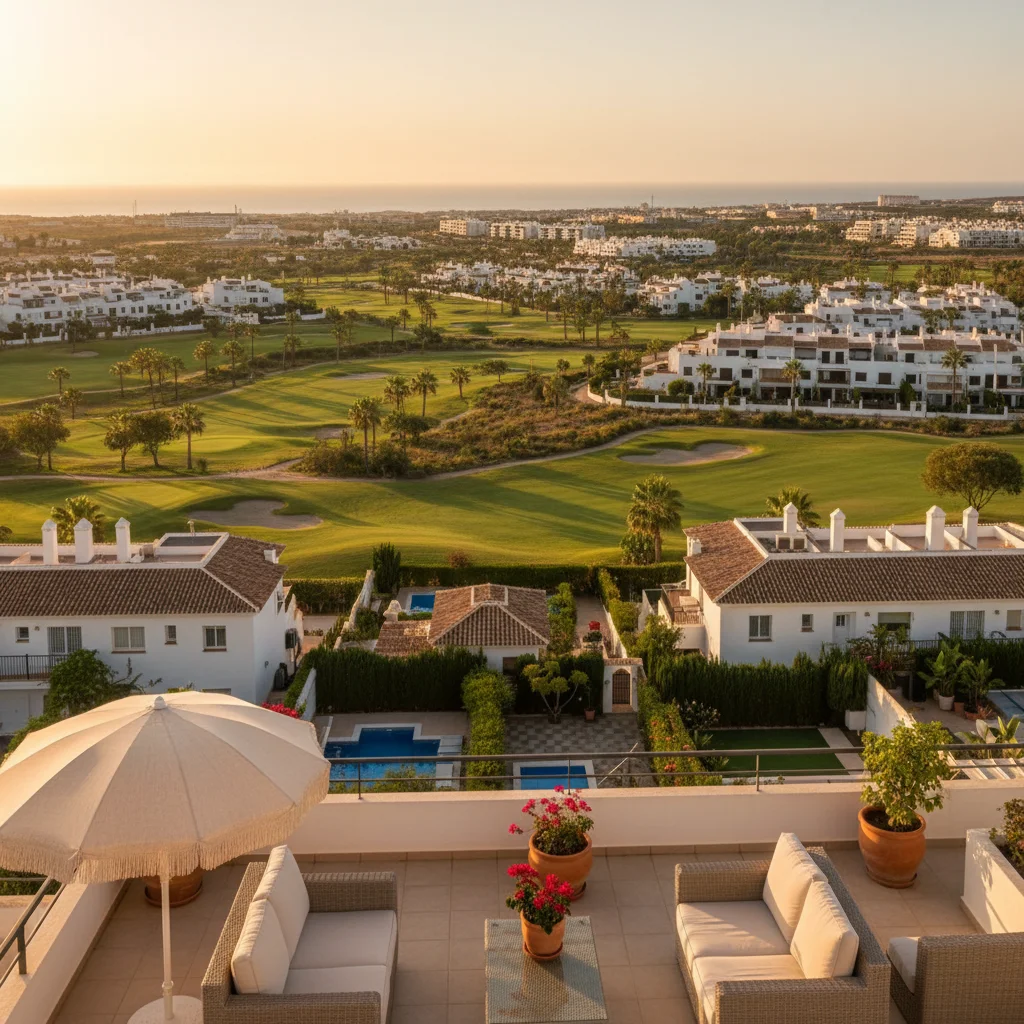
Orihuela Costa is not a single town but a string of purpose-built coastal urbanisations stretching from Punta Prima in the north to Dehesa de Campoamor in the south. Each has its own character, but they share a common thread: expat communities who have embraced outdoor living with an enthusiasm that surprises even the locals. On any given weekend between March and November, the scent of barbecue smoke drifts across rooftop solariums and poolside terraces from La Zenia to Cabo Roig.
The property mix is diverse. Villamartín and Playa Flamenca lean toward apartments and townhouses with communal pools, where rooftop solariums of 15–30 square metres serve as outdoor kitchens, dining rooms, and sunbathing spots all in one. Cabo Roig and Dehesa de Campoamor offer more detached villas with private gardens and larger terraces. Average property prices sit around €200,000, though Campoamor stretches higher.
Social life revolves around the commercial centres — La Zenia Boulevard, the Cabo Roig strip, the Villamartín plaza — and the beach bars and restaurants that line the coast. The British pub culture here is strong, and many expats replicate that social atmosphere at home with regular barbecue gatherings.
For apartment and townhouse owners in Playa Flamenca and Villamartín, space efficiency is everything. A compact kamado grill (around 38–47cm) fits comfortably on most solariums and delivers remarkable versatility — grilling, smoking, roasting, and even baking pizza. Pair it with a foldable prep cart and you have a complete cooking station that stores neatly when not in use.
Villa owners in Cabo Roig, Campoamor, and Dehesa de Campoamor have room for more ambitious projects. Costa Blanca Outdoors recommends a built-in gas BBQ as the foundation, adding a pizza oven for weekend entertaining and a kamado for the dedicated cooks in the family. Natural stone or tiled countertops tie the setup into the existing terrace aesthetic.
Gas is the most popular fuel choice across Orihuela Costa. Butane bombonas are available at petrol stations and hardware stores throughout the area, and many properties have existing gas points. For charcoal and wood, local suppliers serve the corridor from Torrevieja through to Pilar de la Horadada.
Orihuela Costa is our highest-volume delivery area on the southern Costa Blanca. We know the access points for gated communities, the parking restrictions near La Zenia Boulevard, and the best times to deliver to apartment complexes without disrupting communal areas. For solarium deliveries in Villamartín and Playa Flamenca, we confirm staircase and lift access in advance — getting a kamado grill to a fourth-floor rooftop requires planning.
Every delivery includes full setup and a walkthrough. For built-in kitchen projects, we coordinate with local contractors who specialise in terrace construction across the urbanisations and understand each community’s building regulations.
Shade Sails in Orihuela Costa: What You Need to Know
Living on this specific southern stretch of the Costa Blanca since 2019 has taught me that shade is not a decorative luxury but a fundamental requirement for survival during the peak summer months. We are situated in a unique microclimate here, south of Torrevieja and north of the Mar Menor, where the landscape is flatter and significantly drier than the lush, mountainous regions of the northern Marina Alta. This geography means we lack the natural cooling shadows provided by high ridges, leaving our terraces and gardens exposed to a relentless sun that often stays punishingly hot well into the evening. With a permanent population of around 30,000 residents, a huge 60 percent of whom are international expats, there is a distinct outdoor living culture here. Whether you are in the established golf communities of Villamartín or the more modern coastal urbanisations of Playa Flamenca, the desire to replicate an indoor living room or kitchen in an outdoor setting is universal. British, Scandinavian, and German residents have pioneered a style of living that involves spending twelve hours a day outside, but doing so safely requires architectural interventions that can withstand the local environment.
The property landscape in this area is dominated by affordable urbanisation villas and apartments, often with a starting price point around €180,000, which means homeowners are generally looking for high-value, durable solutions rather than temporary fixes. Many of these homes, particularly those in areas like Cabo Roig and La Zenia, feature compact gardens or rooftop solariums that get baked by the sun from 10:00 AM onwards. Unlike traditional awnings which can feel heavy and intrusive on a small terrace, a shade sail offers a lightweight, architectural alternative that maintains a sense of openness. It allows for airflow, which is critical in this region because of the humidity rolling off the nearby salt lakes. In my experience helping over 200 families set up their outdoor spaces, the choice of shade often comes down to how it interacts with the specific Mediterranean wind patterns and the intense UV index we experience here. A shade sail, when tensioned correctly, provides a permanent cooling zone that traditional parasols simply cannot match in terms of stability or coverage area.
The transition toward high-density polyethylene (HDPE) fabrics has changed how we use our outdoor spaces in this part of Spain. In the past, people relied on heavy canvas that trapped heat and eventually rotted due to the humidity. Today, we utilize specialized mesh designs that block up to 95 percent of harmful UV rays while allowing the heat to rise and escape through the fabric. This "chimney effect" can reduce the temperature underneath the sail by as much as 10 degrees Celsius compared to direct sunlight. For residents living near the landmarks of the Zenia Boulevard or the cliffside walks of Cabo Roig, this temperature difference is the deciding factor between a terrace being usable or being a no-go zone between June and September. Because our local community is so diverse, we see a wide range of outdoor uses, from Nordic-style outdoor saunas and plunge pools to the classic British charcoal BBQ setup. Each of these requires a specific shade configuration that doesn't just block the sun but manages the airflow of the entire property.
Practical Expert Advice for the Southern Costa Blanca
When you are planning a shade installation in this specific part of the province, you have to account for the "Calima" dust which is far more frequent here than it is in Valencia or Denia. This fine Saharan sand settles on everything and, when mixed with the morning dew or the humidity from the Torrevieja salt lakes, it creates a muddy layer that can ruin low-quality fabrics. I always tell my neighbors in the local urbanisations to avoid the cheap, polyester sails found in local hardware stores for €30. These are essentially plastic sheets that will sag, trap heat, and eventually tear under the weight of the dust and the occasional torrential "gota fria" rains. Instead, a professional-grade HDPE sail, which typically ranges from €150 for a standard 3x3m size up to €2,000 for a large-scale custom-cut rectangular design, is built to let that dust wash through the mesh or be easily hosed off without staining. The fabric weight is the technical spec you need to watch; anything less than 280g/m² is unlikely to survive more than two seasons in our intense sun. I personally recommend a 340g/m² commercial grade fabric for south-facing terraces in Villamartín where the sun exposure is absolute.
Another critical factor that only a local installer would emphasize is the salt air impact on your hardware. If your property is within three kilometers of the Mediterranean—which covers almost the entirety of Playa Flamenca and La Zenia—you cannot use standard galvanized steel or even Grade 304 stainless steel. The salt-laden humidity will cause "tea staining" or surface rust within months. I insist on Grade 316 stainless steel for all turnbuckles, D-shackles, and pad eyes. This marine-grade hardware is more expensive, but it ensures that the tensioning system doesn't seize up, allowing you to easily remove the sail if a wind warning is issued. Regarding wind, we don't get the same Tramuntana winds as the north, but we do get the "Lebeche," a hot, dry wind from the southwest that can put immense pressure on your wall fixings. Most Spanish homes here are built with hollow ceramic bricks (ladrillo hueco). You cannot simply screw a bolt into these walls; you must use a chemical anchor system with a mesh sleeve to create a solid structural bond. If you are attaching to a communal wall or a shared garden space, you also need to be aware of the Comunidad de Propietarios rules. In many local communities, there are strict bylaws regarding the color of outdoor fabrics to maintain a uniform aesthetic. We usually find that "Desert Sand" or "Silver Grey" tones are universally accepted because they blend with the monocapa (single-layer render) finishes common in our area.
Maintenance in this climate is relatively straightforward if you have the right equipment. Because of the high UV levels, even the best fabrics will eventually show some wear, but a high-quality shade sail should give you 8 to 10 years of service. Every six months, I recommend checking the tension. A loose sail is a dangerous sail because it can "flap" in the wind, which creates a kinetic force far greater than a static load, potentially pulling fixings out of the wall. For those living in the more exposed areas near the Pilar de la Horadada border, where the land opens up and wind speeds increase, I suggest a "hypar" or hyperbolic design. This involves mounting two corners high and two corners low, creating a twist in the fabric. Not only does this look architectural and modern, but it also sheds wind and rain much more efficiently than a flat, horizontal installation. For a standard 4x4m square sail, including marine-grade fixings and professional chemical anchoring, you should expect a budget of roughly €450 to €600 for a DIY-ready kit of high quality, or more if you require custom steel posts.
What We Recommend for Orihuela Costa Properties
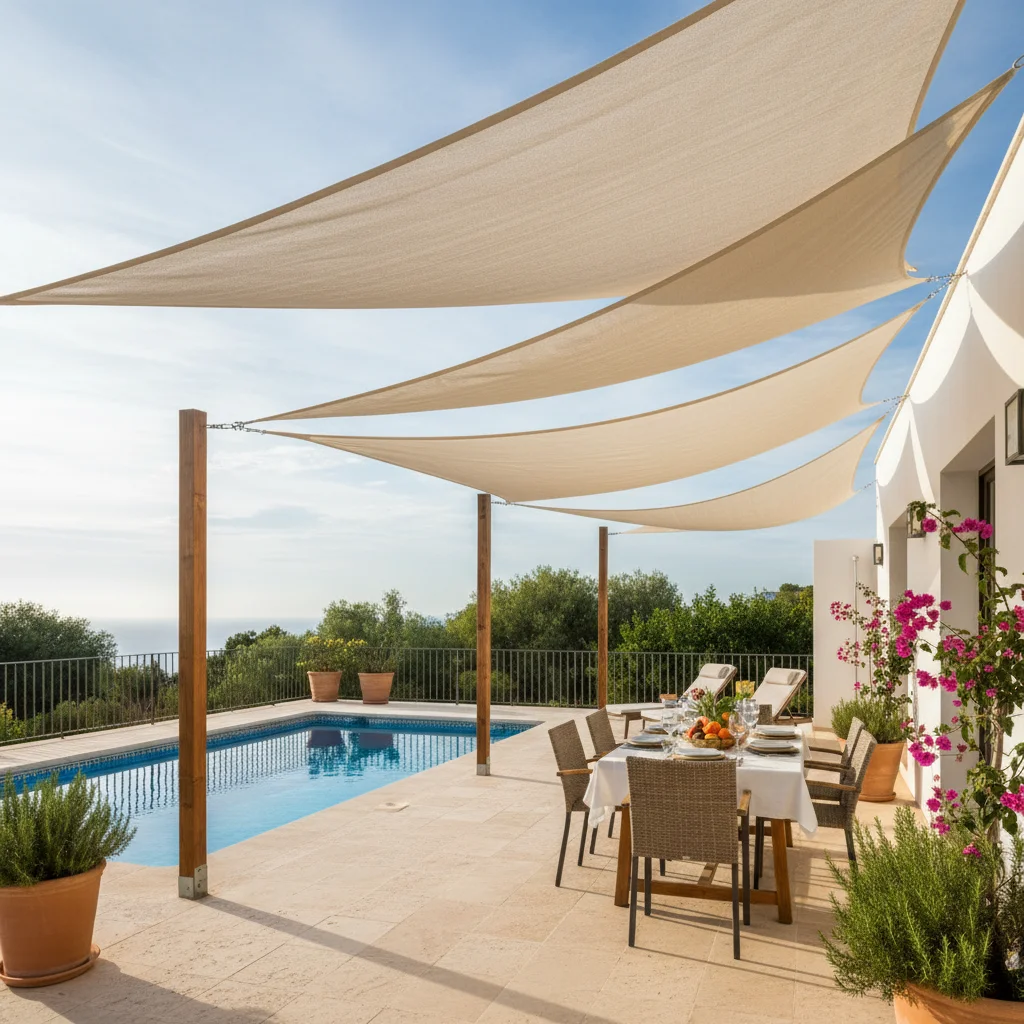
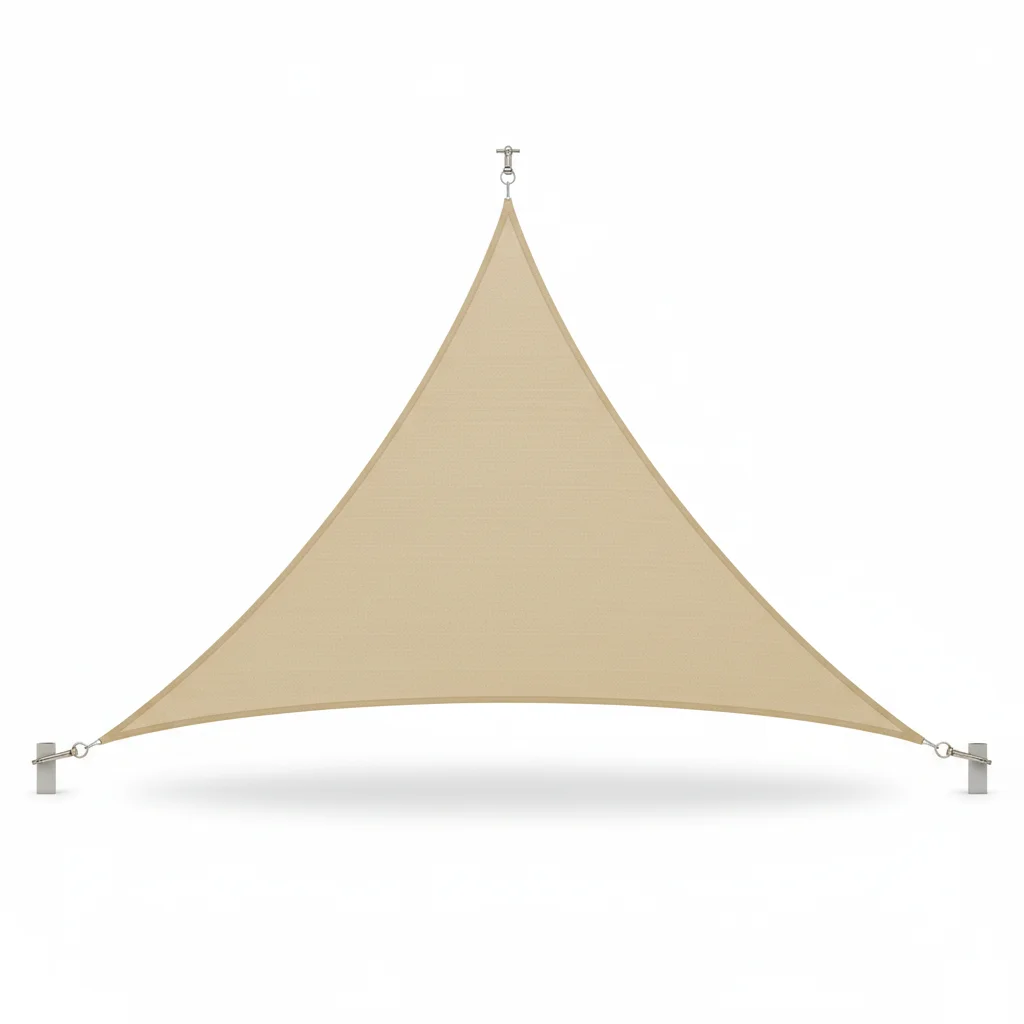
The diversity of property types in this region requires a tailored approach to shading. If you are living in one of the popular "quad" style villas in areas like Playa Flamenca or Villamartín, you often have a L-shaped garden or a tiled front terrace. For these spaces, I almost always recommend a dual-sail configuration. By overlapping two triangular sails of different heights, you create a dynamic shade pattern that moves with the sun throughout the day. This is particularly effective for protecting an outdoor dining area while also keeping the sun off the main sliding glass doors of the lounge. A 5x5x5m triangular sail in a neutral HDPE fabric can be anchored to the house wall on two points and a single 100mm x 100mm galvanized and powder-coated steel post on the third corner. This setup provides roughly 12m² of shade, which is perfect for a six-seater dining table, and will typically cost around €800 including the structural post and professional installation materials.
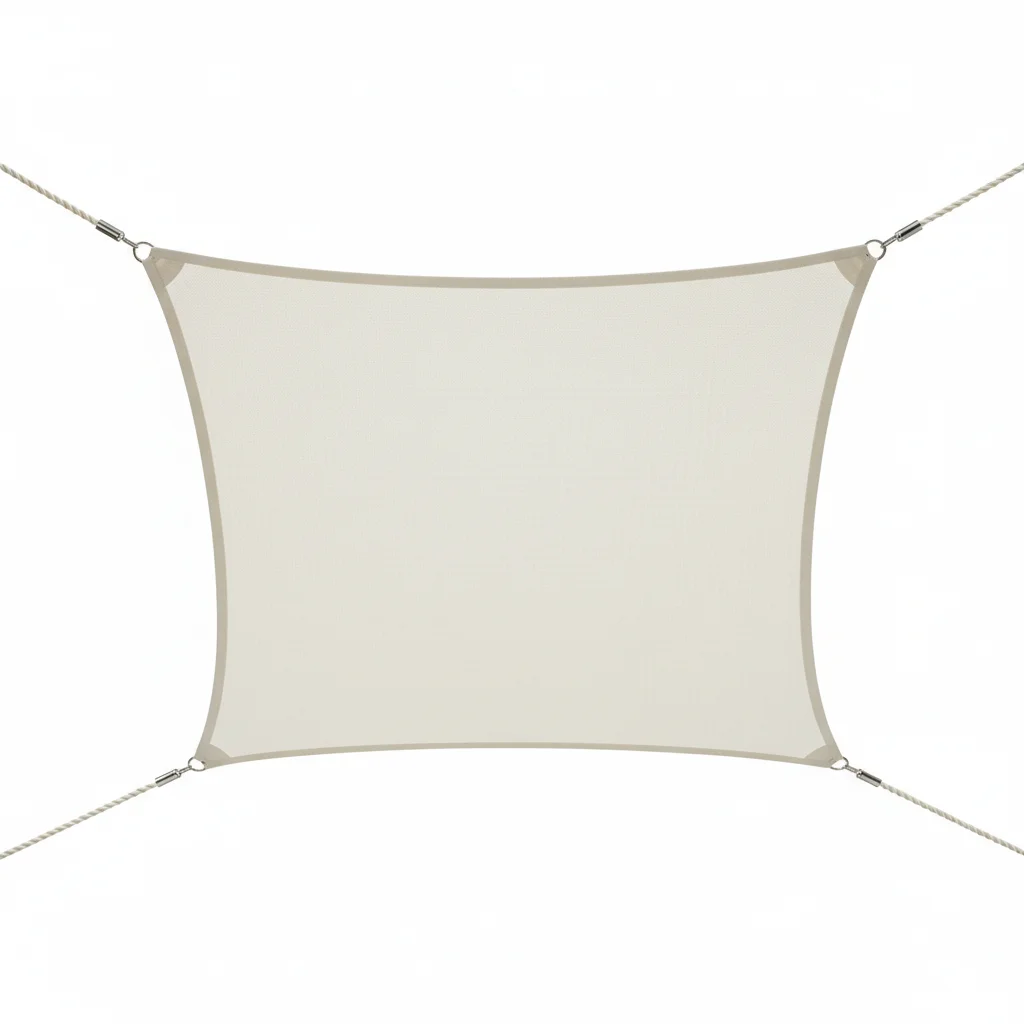
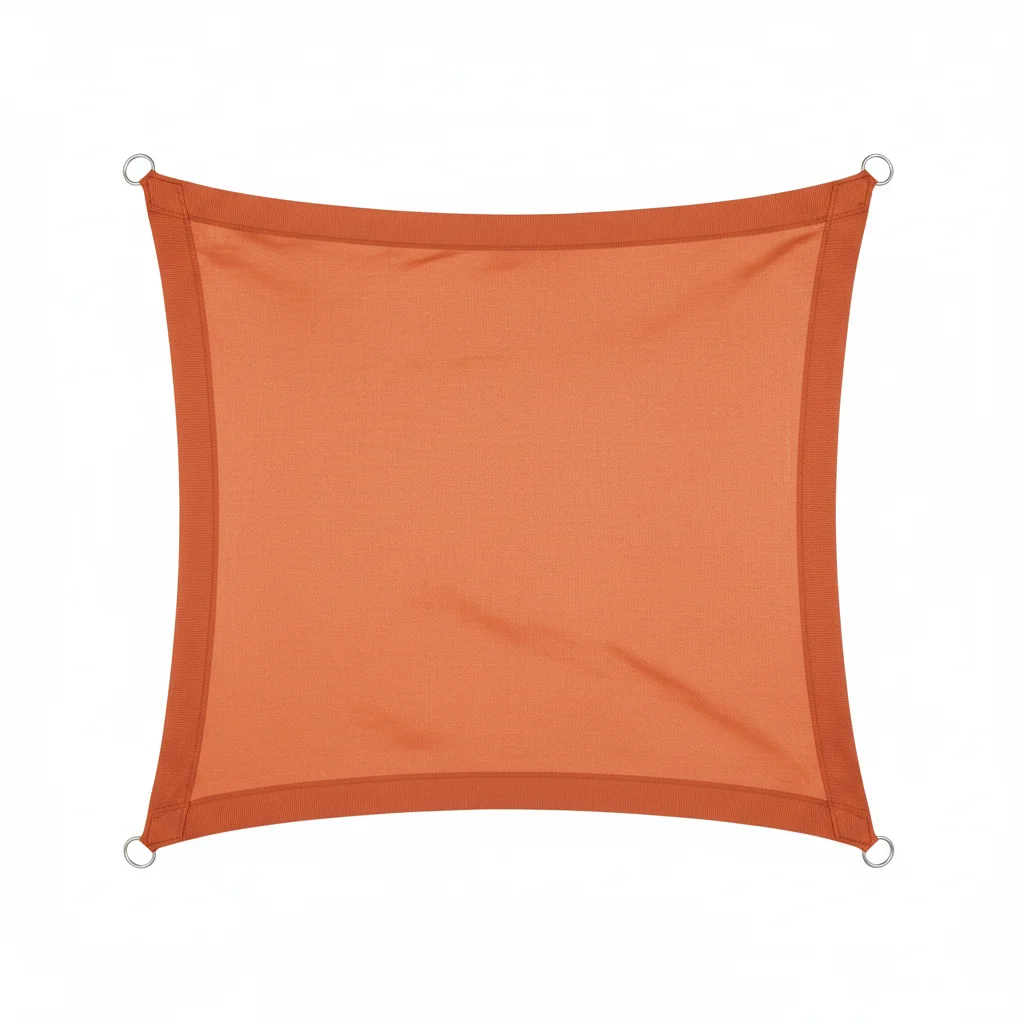
For the many apartment residents in the modern blocks near La Zenia, the challenge is often the balcony or the rooftop solarium. Space is at a premium, and you are often limited in where you can drill. In these cases, a rectangular shade sail is the most efficient use of space. A 3x4m rectangle can cover almost the entire usable area of a standard Spanish balcony. However, you must be careful with the height of the fixings to ensure you don't block your neighbor’s view, as this is a frequent source of "comunidad" disputes. If you have a rooftop solarium, the wind loads are significantly higher than at ground level. Here, I recommend smaller, modular sails or perhaps integrating a shade sail with a bioclimatic pergola or a heavy-duty parasol. By combining products, you get the best of both worlds: the permanent, structural shade of a sail for the main lounge area, and the flexibility of a parasol for the sun-lounger zone. This tiered approach allows you to adjust your shade as the seasons change, as the low winter sun requires a different strategy than the overhead mid-summer sun.
We also see many homes with private pools in the more spacious parts of Cabo Roig. Shading a pool is a delicate balance; you want to protect swimmers from UV rays, particularly children, but you don't want to block the sun so much that the water never warms up. A large, breathable shade sail positioned over the shallow end or the "beach entry" of the pool is the ideal solution. Because the HDPE fabric allows air to circulate, it doesn't create a "greenhouse" effect over the water. For these larger spans, which might require a 6x6m or 7x5m sail, the tensioning becomes critical. We use heavy-duty M10 or M12 rigging screws to ensure the fabric remains taut. A project of this scale, involving custom fabric and potentially two or three structural columns, would sit at the higher end of the price bracket, likely between €1,500 and €2,000, but it adds significant value to the property and creates a genuine "resort" feel that is highly sought after in the local resale market.
Delivery and Local Knowledge in the South
Operating out of this region since 2019, I have navigated almost every narrow urbanisation street and dead-end "calle" from the heart of the coast out to the salt lakes. We provide full delivery and consultation services throughout this area, including nearby Torrevieja, Pilar de la Horadada, San Miguel de Salinas, and Rojales. One thing you quickly learn when working in these towns is that logistics can be tricky. Many of the newer developments have restricted access for large delivery vehicles, and the summer traffic on the N-332 can turn a ten-minute trip into an hour-long ordeal. Because we are local, we plan our installations and deliveries to avoid these bottlenecks, ensuring that we arrive when we say we will. We also understand the local building styles; we know which urbanisations used high-quality concrete and which ones used the softer, more porous bricks that require extra care when mounting heavy-duty shade sails.
Our knowledge extends to the local weather nuances that a national or international supplier simply wouldn't know. For example, we know that the afternoon breeze often picks up around 4:00 PM in the summer, blowing in from the sea. This "Embat" style wind needs to be accounted for in the orientation of your sail. If the sail is angled incorrectly, it can act like a giant wing, creating lift that puts unnecessary stress on your roof tiles or wall plates. We also know the specific logistics of the AP-7 and the various "urbanizacions" like Campoamor or Las Ramblas, where property layouts often feature unconventional angles that make "off-the-shelf" shade solutions impossible to fit correctly.
Whether you are looking to shade a small balcony in a busy apartment block or a large poolside terrace in a quiet villa, we bring the specific tools and local experience needed for this environment. We don't just drop a box at your door; we understand the chemistry of the anchors, the metallurgy of the stainless steel, and the physics of the wind loads in this specific corner of Spain. If you are unsure about the best configuration for your space, we offer a free consultation where we can look at your orientation, wall types, and community rules to recommend a solution that will last for years. Living here is about enjoying the sun, but doing so on your own terms. A well-engineered shade sail is the most effective way to claim back your terrace from the heat and create a space where your family can actually spend their time. Reach out to us, and let's discuss how to transform your outdoor area into a functional, cooled environment that stands up to the unique demands of our Mediterranean home.
 JW'"
/>
JW'"
/>